Exclusive vs Non-Exclusive Licensing: Differences & Examples
Key Takeaways
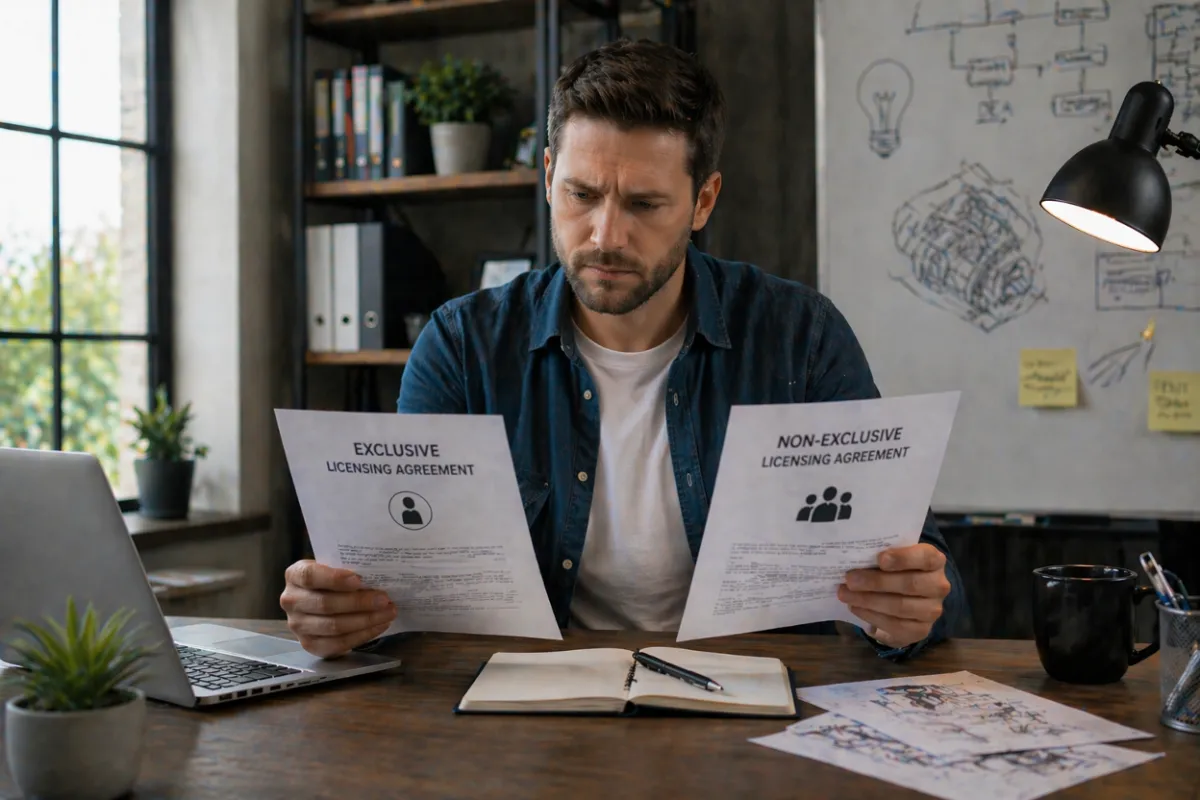
An exclusive license grants a single licensee the sole right to use a patented invention within the agreed scope, meaning no one else can commercialize the invention under those terms.
A non-exclusive license allows the licensor to grant the same rights to multiple licensees simultaneously, enabling widespread use of the invention across different industries.
The key differences come down to control, revenue, and strategy. Exclusive licenses offer the licensee stronger market protection and justify bigger investments, while non-exclusive licenses give the licensor broader reach and multiple revenue streams.
Real-world examples illustrate both approaches in action. Genentech granted Roche an exclusive license to market Herceptin outside the U.S., while Qualcomm takes a non-exclusive approach by licensing its wireless communication patents to virtually every major smartphone maker worldwide.
At Rabbit Product Design, we help you build products worth owning, not just licensing. We take your idea from concept to commercialization through a proven end-to-end process, so you can create a product that's built to ship and sell as a real business.
Exclusive vs Non-Exclusive Licensing: The Core Difference
The single biggest difference between exclusive and non-exclusive licensing comes down to one thing: who controls the rights, and how many people can hold them at once.
An exclusive license transfers one or more of the intellectual property (IP) owner's rights to a single licensee. A non-exclusive license, by contrast, allows the original owner to share the same rights with multiple parties simultaneously.
While the specific legal rules vary depending on whether you're dealing with patents, copyrights, or trademarks, the core commercial logic of exclusive versus non-exclusive licensing applies across all forms of intellectual property.
The examples and principles in this article cover both patent licensing (common for physical products and technology) and copyright licensing (common for software, music, and creative works).
What an Exclusive License Actually Means
An exclusive license is a formal transfer of one or more of the IP owner's rights to a third party. Once that transfer happens, the original owner no longer holds those specific rights within the scope of the license, whether that scope is defined by territory, field of use, time period, or a specific right within the IP bundle.
The exclusive licensee assumes legal ownership of the licensed rights, which is why they are treated differently under U.S. IP law. Whether the underlying IP is a patent, copyright, or trademark, exclusivity creates a legally protected position that allows the licensee to act much like the original owner within the agreed scope.
If bringing your invention or creative work to market requires a significant investment in manufacturing, marketing, and distribution infrastructure, a licensee is far more likely to make that investment if they know no competitor will have access to the same rights.

An exclusive license transfers ownership to the licensee.
What a Non-Exclusive License Actually Means
A non-exclusive license gives a licensee permission to exercise one or more IP rights, but it does not transfer ownership of those rights. The IP owner retains full ownership and can grant the same rights to as many other parties as they choose.
Multiple companies can simultaneously hold non-exclusive licenses under the same patent, use the same copyrighted software, or distribute the same branded goods under a trademark license.
This model is especially common in technology, software, and telecommunications, where broad adoption drives value. A patented wireless standard licensed to hundreds of device makers, or a software product licensed to thousands of business users, can generate far more cumulative revenue than any single exclusive deal would.
For creators and IP owners, non-exclusive licensing is a way to monetize broadly without surrendering control. For licensees, it offers a lower-cost entry point, but with the understanding that competitors may have access to the same IP.

Multiple companies or industries can hold a non-exclusive license to a specific product.
The Legal Differences between Exclusive & Non-Exclusive Licensing
Beyond the commercial implications, the legal differences between exclusive and non-exclusive licenses are specific and consequential. Here's a breakdown of the key legal distinctions:
Who Can Sue for Infringement
This is one of the most practically important legal differences. Because an exclusive licensee is treated as an owner of the licensed rights, they generally have legal standing to bring an infringement lawsuit against third parties who violate those rights, whether the underlying IP is a patent, copyright, or trademark.
A non-exclusive licensee does not have this standing. If someone infringes on rights covered by a non-exclusive license, only the original IP owner can take legal action, leaving the licensee without direct recourse. For a licensee making a major investment in manufacturing, marketing, or distribution, this difference can be the deciding factor in whether to pursue a deal.
The Writing Requirement for Exclusive Licenses
Exclusive licenses generally must be in writing and signed by the IP owner to be enforceable. This rule applies under both U.S. patent law and copyright law, and an oral agreement, no matter how detailed or witnessed, will typically not create a legally valid exclusive license.
Non-exclusive licenses operate under a more relaxed standard. Depending on the type of IP involved, they can be granted in writing, verbally, through conduct, or even implied by the circumstances of how the rights were used or delivered. That flexibility makes non-exclusive arrangements easier to create, but also easier to dispute when terms aren't clearly documented.
How Recordation Affects Both License Types
Recordation refers to registering a license transfer with the relevant government office: the U.S. Patent and Trademark Office (USPTO) for patents and trademarks, and the U.S. Copyright Office for copyrights. While not mandatory in most cases, recordation creates a public record of the license and establishes legal priority in the event of conflicting transfers.
For exclusive licenses, recordation is strongly recommended. A recorded exclusive license generally takes priority over an unrecorded transfer of the same rights, protecting the licensee's position. For non-exclusive licenses, recordation is less critical but still useful for establishing the terms and timing of the grant.
Real-World Examples of Each License Type
Abstract concepts become far clearer with concrete examples. The following two scenarios illustrate exactly how exclusive and non-exclusive licenses function in practice, and why the choice between them carries real commercial and legal consequences.
Exclusive License Example: Genentech: Roche for Herceptin (1998)
Genentech is a South San Francisco-based biotech company that invented and developed Herceptin (trastuzumab), a groundbreaking monoclonal antibody treatment for HER2-positive metastatic breast cancer. In 1998, the company signed a licensing agreement granting Roche exclusive marketing rights outside the United States.
The deal was structured so that Roche paid a substantial up-front fee, plus cash milestones tied to product development activities, contributed equally with Genentech to global development costs, and made royalty payments on product sales. Genentech, meanwhile, retained full marketing rights within the United States.
This is a textbook example of an exclusive license because no other company outside the U.S. could legally market Herceptin—Roche alone had that right. Exclusivity was especially valuable here because it gave Roche the confidence to invest heavily in international regulatory filings, distribution networks, and market education around a completely novel cancer therapy.
At the same time, Genentech retained ownership of the underlying patents and drug, collected royalties, and preserved its own commercial position in the lucrative U.S. market.
Non-Exclusive License Example: Qualcomm's Mobile Patent Licensing
Qualcomm owns one of the world's largest and most valuable patent portfolios covering wireless communication technologies, including foundational inventions for CDMA, 3G, 4G LTE, and 5G standards.
Rather than granting exclusive rights to any single smartphone maker, Qualcomm licenses these patents non-exclusively to virtually every major device manufacturer, including Apple, Samsung, Xiaomi, Huawei, and many others.
The company earns a percentage of the price of every device sold that uses its technology, generating significant revenue beyond its chip business.
Unlike the Genentech–Roche deal, where exclusivity was used to incentivize focused investment in a single product, Qualcomm's non-exclusive approach works precisely because mobile devices are a massive, multi-vendor market, and exclusivity would cripple the entire industry and limit Qualcomm's own revenue.
Exclusive vs Non-Exclusive Licensing: Comparison Table
Why You Should Start Building With Rabbit Product Design
Rabbit Product Design offers in-house patent research, manufacturing, brand development, and go-to-market strategy.
Whether you choose an exclusive or non-exclusive licensing structure, the strategy only pays off if there's a real, market-ready product behind it, and that's where most inventors get stuck. At Rabbit Product Design, we don't chase licensing deals or treat patents as the finish line. Instead, we believe that the reliable way to make money from an invention is to build it, manufacture it, and sell it as a real business.
Our end-to-end product development system takes physical products from a rough idea through production, covering feasibility, engineering, prototyping, manufacturing setup, branding, and launch planning. If you're tired of theorizing about licensing structures and ready to build something tangible, get in touch with us today and start turning your idea into a real, sellable product.
Start building with Rabbit Product Design today →
Frequently Asked Questions (FAQs)
Can a non-exclusive licensee sue for infringement?
Generally, no. A non-exclusive licensee does not own any of the licensed rights; they only have permission to use them. Because they are not considered owners under patent, copyright, or trademark law, they typically have no legal standing to bring an infringement lawsuit against a third party. Only the original IP owner can take legal action when the rights covered by a non-exclusive license are infringed, though some agreements require the owner to enforce on the licensee's behalf.
Can you switch from a non-exclusive to an exclusive license later?
Yes, but it depends on the existing agreements. If outstanding non-exclusive licenses have expired or include termination clauses, the IP owner can wind those down and grant an exclusive license to another party. However, if other non-exclusive licensees still hold valid rights, a true exclusive license cannot be granted until those agreements end, since exclusivity requires that no one else holds the same rights within the defined scope.
What happens if an exclusive licensee breaches the agreement?
The consequences of a breach depend on the specific terms written into the license agreement, but a well-drafted exclusive license should include clear remedies. If the licensee fails to meet performance minimums, the licensor typically has the right to terminate the exclusivity clause, the entire license, or both. Termination returns the rights to the licensor, who can then re-license them to another party.
Can a copyright owner grant both exclusive and non-exclusive licenses at the same time?
Yes, but only if they are covering different rights or different scopes. Because copyright is a bundle of distinct rights, an owner can grant an exclusive license for one specific right, while simultaneously granting non-exclusive licenses to other parties for a completely different right, such as the right to publicly display the work.
How does Rabbit Product Design approach licensing when developing a new product?
At Rabbit Product Design, we don't simply pursue licensing deals or build products with the goal of licensing them out. Instead, we focus on helping inventors develop products they can manufacture, sell, and own as a real business, because that's the most reliable path to turning an idea into lasting revenue.
Our end-to-end process takes your concept through feasibility, design, engineering, prototyping, and manufacturing setup, delivering a product built to ship, not one that sits idle waiting for a licensing deal that may never come.
*Disclaimer: This content is for educational purposes only and not financial, legal, or business advice. Figures vary by circumstance. Consult qualified professionals before making decisions. For personalized guidance, contact Rabbit Product Design.