
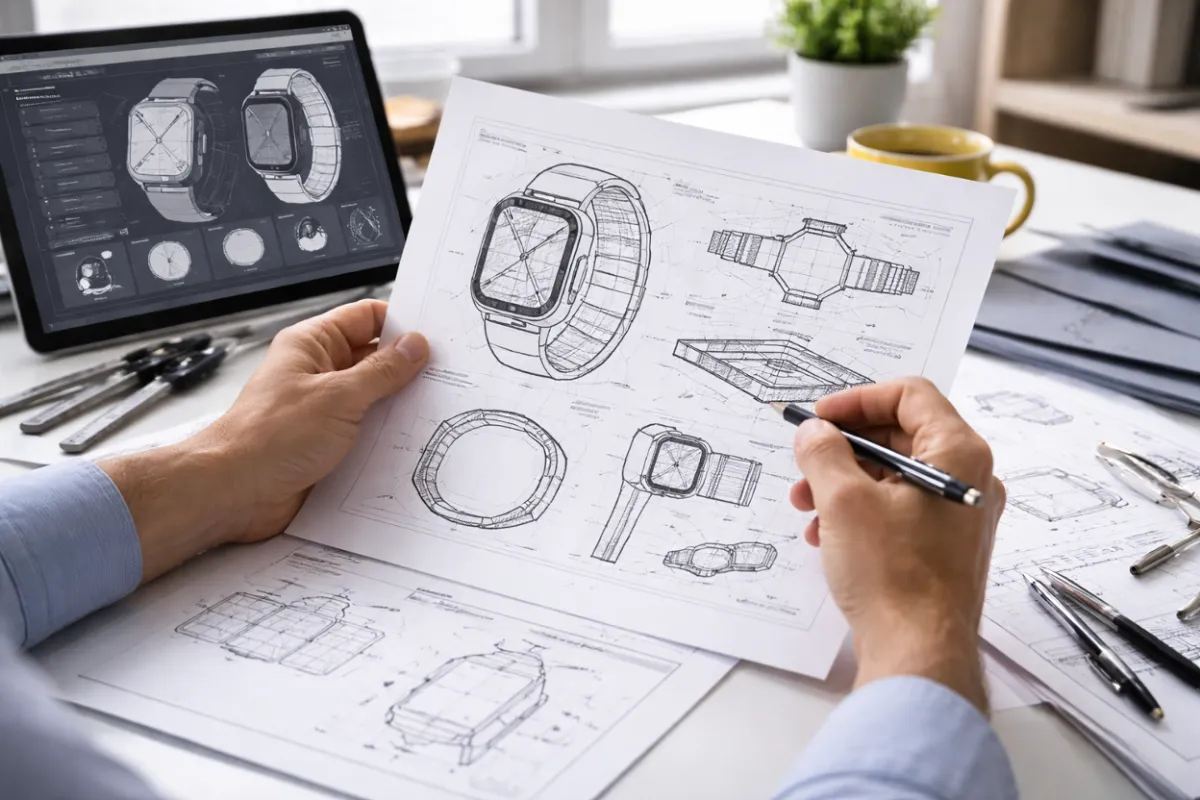
Design Patent Drawings: Requirements & Examples
Key Takeaways
In a design patent, the drawings are the claim, and if your drawings are incomplete, inconsistently styled, or non-compliant with USPTO formatting requirements, your entire protection scope disappears.
The USPTO requires seven standard views (front, rear, right side, left side, top, bottom, perspective view), and omitting even one without written justification can trigger an Office Action rejection.
In design patent applications, color drawings are permitted without a petition, provided the application includes the required number of color drawing sets and a statement in the specification; color photographs in design applications follow similar rules.
Real-world design patents, such as Apple's iPhone (US D618,677) and Coca-Cola Bottle Design Patent (US D48,160), demonstrate exactly how professional drawing sets are structured.
At Rabbit Product Design, we believe the most valuable drawing is the one your engineer uses to build a real, manufacturable product. Our end-to-end development process is built to take your invention from concept through production-ready prototyping and market launch, so that any patent protection you pursue is backed by commercial success.
Your Design Patent Lives or Dies by Its Drawings
In a design patent, the drawings are the claim. They are not supplementary materials or visual aids; they define exactly what the USPTO will protect. A drawing set that is incomplete, improperly formatted, or missing required views can shrink your protection scope or trigger an Office Action rejection before your application is even reviewed.
USPTO format requirements for patent drawings include paper size, line thickness, and the number of figures. You must submit your patent drawings on white, non-shiny paper, and the lines must be clean, sharp, and uniformly black. Additionally, the USPTO expects to see seven standard views, which present the full three-dimensional appearance of the design you intend to patent.
Below is a full breakdown of each requirement, with real drawing examples from Apple and Coca-Cola to show how compliant, professionally structured patent drawings are built.
USPTO Format Requirements for Design Patent Drawings
Accepted Paper Size, Margins & Orientation
All patent drawings submitted to the USPTO must be on white, non-shiny paper. The two accepted sizes are either 21.0 cm by 29.7 cm (A4) or 21.6 cm by 27.9 cm (8.5 × 11 inches, letter size). Sheets must be numbered consecutively, and each sheet number should appear centered at the top of the usable drawing surface, but not in the margin itself.
Here’s a breakdown of the margin requirements:
Top margin: minimum 2.5 cm.
Left margin: minimum 2.5 cm.
Right margin: minimum 1.5 cm.
Bottom margin: minimum 1.0 cm.
Paper: white, non-shiny, either A4 or 8.5 × 11 inches.
Sheet numbering: centered at the top of the usable drawing surface (the sight), not in the margin.
Line Weight, Ink Color & Surface Shading Rules
All lines in a design patent drawing must be clean, sharp, and uniformly black. The USPTO requires that lines be thick enough to reproduce clearly when scanned or photocopied and that they not be gray, faded, or inconsistent in weight.
Unlike utility patent drawings, which sometimes use minimal shading, design patent drawings require proper surface shading to show the design's three-dimensional contours and character.
Flat, unshaded drawings of three-dimensional objects are generally not acceptable for design patents because they fail to communicate the actual appearance of the article.
How to Number Figures & Reference Characters Correctly
Each view in a design patent drawing must be labeled as a separate figure, using Arabic numerals preceded by “FIG.” For example, FIG. 1, FIG. 2, FIG. 3.
The figures must be numbered consecutively in the order they appear, and the brief description of drawings in the written portion of the application must correspond exactly to these figure labels.
Reference characters must be consistent throughout the entire application. If a feature is labeled “10” in FIG. 1, it must be labeled “10” in every other figure where it appears.
Black-and-White vs. Color Drawings: When Each Is Allowed
The default standard for design patent drawings is black-and-white line art. This is a USPTO requirement.
In design patent applications, color drawings are permitted without a petition, provided the application includes the required number of color drawing sets and adds the required statement to the specification. In utility patent applications, color drawings require a granted petition explaining why color is the only practical medium for disclosure.
When color drawings are filed, one set is required if submitted electronically via the USPTO Patent Center, or three sets if filed on paper.
Photographs follow similar rules. They are generally acceptable for design patents when a drawing cannot illustrate the invention, but they must be of sufficient quality to clearly show all features of the design.
Black-and-white photographs are preferred over color photographs, and both types must meet the same margin and paper size standards as line drawings. Digital files submitted electronically via the USPTO Patent Center must be in formats such as PDF or TIFF and meet resolution requirements to ensure clarity.
Required Views for a Complete Design Patent Drawing Set
The USPTO expects to see the article in its entirety from every angle, and failing to provide that indicates the disclosure is inadequate.
The 7 Standard Views USPTO Expects to See
A complete design patent drawing set includes seven standard views that together present the full three-dimensional appearance of the claimed design.
Front View: The primary face of the article, typically the most recognizable angle.
Rear View: The back of the article, directly opposite the front.
Right Side View: The article’s right side as seen from the front.
Left Side View: The article’s left side as seen from the front.
Top View: Looking directly down at the article.
Bottom View: Looking directly up at the article from beneath.
Perspective View: A three-quarter angle view that conveys the overall three-dimensional character of the design.
When You Can Omit a View Without Rejection
Not every design patent requires all seven views. If two or more views of an article are identical, you may omit the redundant view, as long as the application includes a statement in the brief description of drawings explaining the omission.
Similarly, if a surface contains no ornamental design, that view may be omitted with a corresponding statement. What the USPTO will not accept is a silent omission, where a view is simply absent with no explanation.
How Broken Lines Show Unclaimed Portions of Your Design
Broken lines are one of the most strategically important tools in a design patent drawing. Any feature shown in solid lines is considered claimed. Any feature shown in broken lines (dashed lines) is considered environmental context or unclaimed subject matter.
For example, if you are patenting the ornamental design of a smartphone case but want the phone itself to appear for context without being part of the claim, you would draw the phone in broken lines. The case, in solid lines, is what is actually protected.
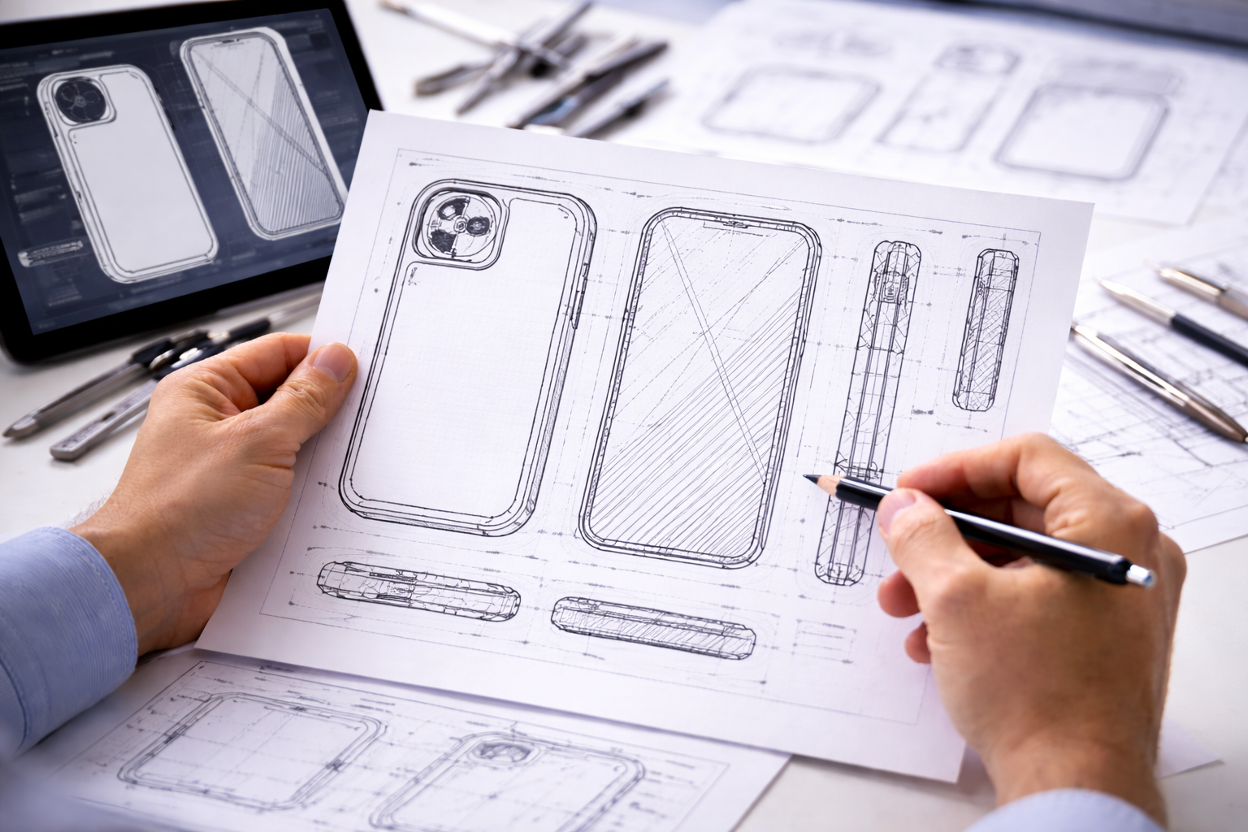
Broken lines distinguish between claimed and unclaimed portions of your design.
Real Design Patent Drawing Examples
Two of the most well-known and instructive examples come from Apple and Coca-Cola, both companies with long histories of using design patents as serious IP assets.
Example 1: Apple iPhone Design Patent (US D618,677)
Apple's design patent US D618,677 covers the ornamental design of the iPhone's front face, specifically its black, rounded rectangular form. The drawing set is a textbook example of how to construct a complete, strategically precise set of patent figures.
Apple included perspective views and standard orthographic views (front, rear, top, bottom, left side, and right side), along with clean, precise surface shading that clearly communicates the device’s smooth, curved surfaces and sharp edges with no ambiguity.
What makes this drawing set particularly instructive is how Apple used both solid and broken lines. The screen display content is shown in broken lines, meaning Apple deliberately chose not to claim the content displayed on the screen as part of the protected design. The device's physical form is entirely in solid lines.
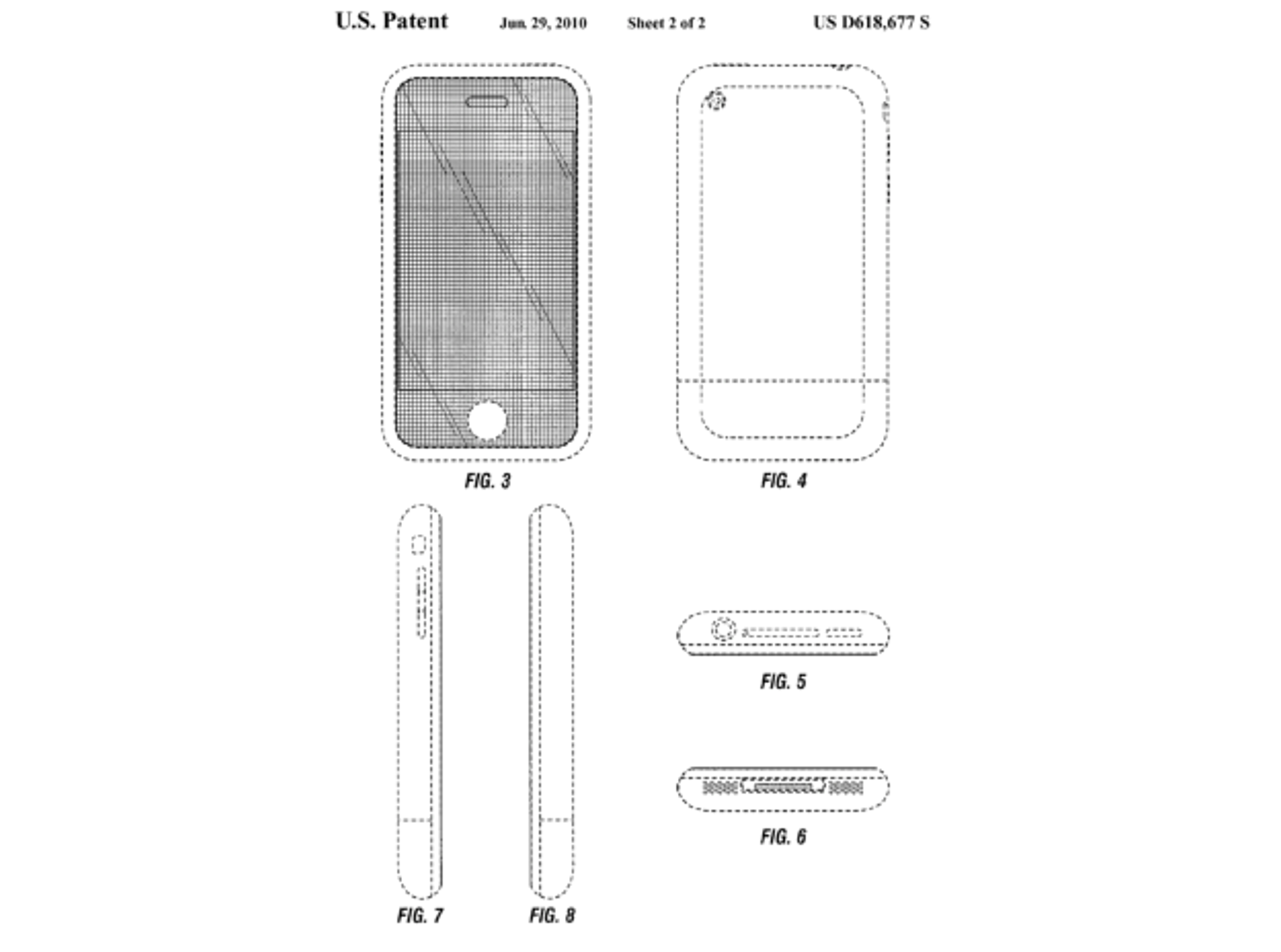
Apple’s design patent is a good example of how you can use broken lines to depict your protected design (Image source: Research Gate).
Example 2: Coca-Cola Bottle Design Patent (US D48,160)
The Coca-Cola contour bottle design patent is one of the oldest and most recognized examples of design patent protection in American history. The original design patent was filed in August 1915 and granted on November 16, 1915, protecting the iconic hourglass silhouette of the Coca-Cola bottle.
The drawing set used orthographic views to clearly capture the bottle’s distinctive proportions: the narrow waist, the flared base, and the ribbed surface texture that made it instantly recognizable on store shelves and in the dark by touch alone.
The design patent does not protect the Coca-Cola bottle’s function. What is protected is the specific visual and tactile character of the bottle’s exterior form, as disclosed through the drawings. That protection has helped Coca-Cola maintain brand recognition and fight imitators for over a century.
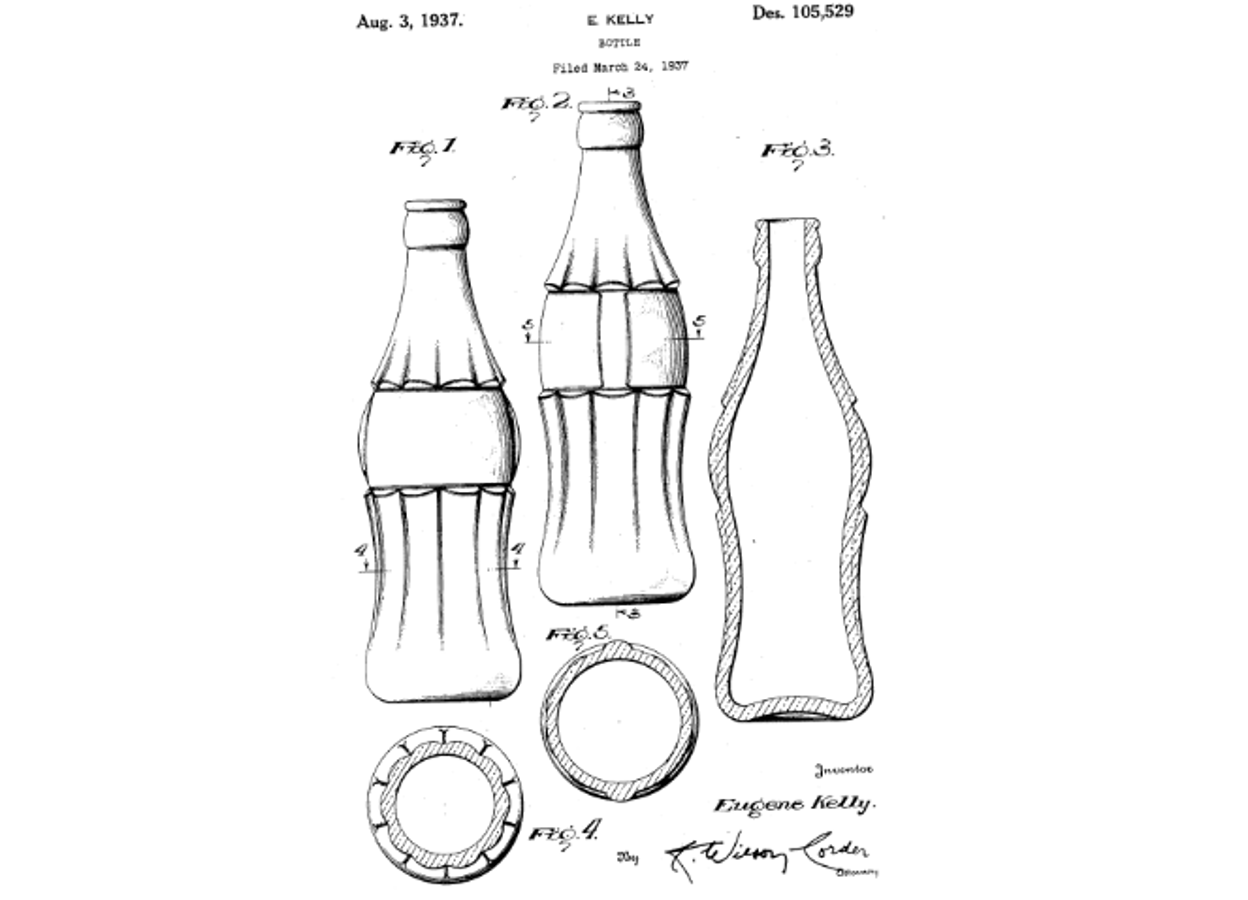
Coca-Cola’s bottle design patent protects the visual characteristics of the bottle (Image source: Lexis Nexis).
Build, Launch & Sell with Rabbit Product Design
Getting your design patent drawings right is what determines how much protection your patent actually provides. Every view, line weight, and figure label either strengthens or limits your claim. Use the requirements and real-world examples above as your baseline before you file.
At Rabbit Product Design, we believe the path to commercial success runs through production, not only paperwork, and our end-to-end product development process, led by Adam Tavin and a team of senior engineers, is built around that belief. We strategically support patent research as part of our process, but our core mission is to get your product built, launched, and selling as efficiently as possible. If you want to build a product that actually ships, start here.
Start building the business your idea deserves.
Frequently Asked Questions (FAQs)
Can I submit photographs instead of drawings for a design patent?
Yes, photographs are permitted in design patent applications, but only when the invention cannot be adequately illustrated through line drawings. Black-and-white photographs are preferred over color photographs. Any photographs submitted must meet the same margin and paper size requirements as line drawings, and they must be sharp enough to clearly show all features of the claimed design without ambiguity.
How many views are required in a design patent application?
A standard complete design patent drawing set includes seven views: front, rear, right side, left side, top, bottom, and perspective. Some views may be omitted if they are identical to another view or show no ornamental design, but any omission must be explicitly explained in the brief description of drawings.
What do broken lines mean in a design patent drawing?
Broken lines in a design patent drawing indicate features or portions of an article that are not part of the claimed design. They are used to show environmental context or to depict portions of the article that the applicant has deliberately chosen to exclude from protection. Only the features shown in solid lines are legally claimed and protected by the issued design patent.
Can I amend my design patent drawings after filing?
Amendments to design patent drawings are permitted only if they do not introduce new matter, meaning they cannot add any visual information that was not already present in the original filing. Minor corrections, like fixing a broken line that was accidentally rendered in solid form, may be acceptable.
How does Rabbit Product Design help with patents?
At Rabbit Product Design, we support patent research as a strategic step, but our core belief is that the strongest protection for any invention is a manufactured, market-tested product with a real business behind it, and that is exactly what we are built to help you create. Our end-to-end development process, led by senior engineers with an average of 27+ years of experience, moves your invention from feasibility and concept development through industrial design, engineering, production-ready prototyping, manufacturing setup, and market launch.
*Disclaimer: This content is for educational purposes only and not financial, legal, or business advice. Figures vary by circumstance. Consult qualified professionals before making decisions. For personalized guidance, contact Rabbit Product Design.