
Why Home Products Fail Before Launch - Copy
Avoid Costly Mistakes in Development
Executive Summary
Home products — from smart thermostats to kitchen gadgets to plastic-molded toys — succeed or fail based on decisions made months before a single unit reaches a shelf. The riskiest choices involve where to manufacture, which material and process to use, how early to test for manufacturability, and which safety certifications apply. Skipping any of these steps rarely saves money; it usually just delays the bill. This article walks through each decision with practical, evidence-based guidance so you can move forward with fewer surprises.
A founder we'll call typical spends eighteen months designing a smart kitchen device. The CAD files look flawless. The functional prototype works on the bench. Then the injection mold arrives from an overseas supplier, and the enclosure doesn't snap together the way it did in the 3D-printed sample. Three months and $40,000 later, a redesign fixes it — right before the compliance lab flags a missing FCC test that should have been planned a year earlier.
This scenario is common, and it's avoidable. The difference between a smooth launch and an expensive scramble almost always comes down to a handful of decisions made early: where you manufacture, what materials and processes you choose, how seriously you test for manufacturability before tooling, and which regulatory requirements actually apply to your product category.
Understanding these four decisions matters because each one touches cost, schedule, and risk in ways that are easy to underestimate. A mold cut for the wrong process can waste tens of thousands of dollars. A missed safety standard can block a product from ever reaching store shelves. A supplier chosen for a slightly lower unit price can create months of delay when a shipment gets held at customs or a design revision takes three weeks to communicate across time zones.
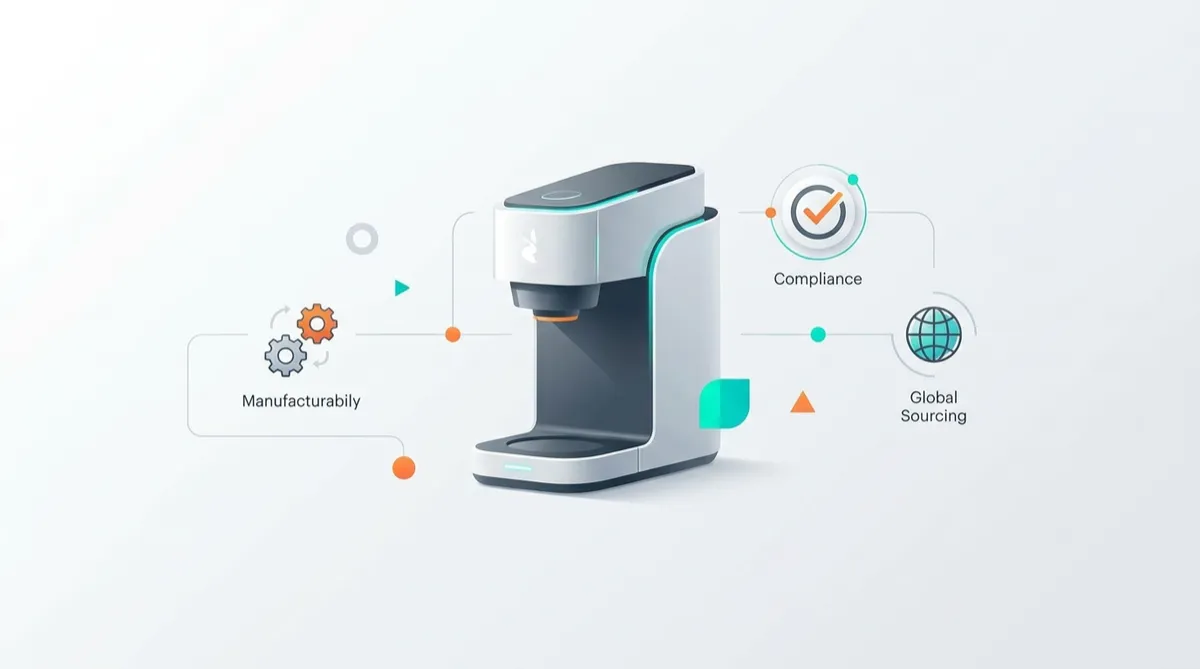
This article looks at each of these decision points — domestic versus overseas manufacturing, material and process selection, design for manufacturability, and regulatory compliance — and explains what inventors, founders, and product teams need to know before committing capital.
Choosing Where Your Product Gets Made
The instinct to chase the lowest unit price overseas is understandable, but it often hides costs that only show up later. Persistent geopolitical instability and tariff uncertainty, combined with better domestic automation, have pushed many manufacturers to reconsider where they build.
Due to persistent and rising geopolitical instability, trade policy and tariff uncertainty, along with the availability of advanced automation technologies stateside to lower costs and speed up production, supply chain strategies are changing. This isn't a temporary blip. Many business leaders now recognize and work to maximize the inherent advantages of domestic supply chains in their planning.
The national data backs this up. The Reshoring Initiative 2024 Annual Report shows that 244,000 U.S. manufacturing jobs were announced in 2024 via reshoring and foreign direct investment, continuing the nation's push to rebuild domestic production capacity. That said, domestic manufacturing isn't automatically cheaper. Without comprehensive reforms, U.S. manufacturing costs remain 10–50% higher than offshore competitors, driving most import decisions.
So why do so many home product teams still choose domestic partners for critical runs? A few consistent reasons show up across the industry:
Communication quality: Poor or inefficient communication is a common symptom of working with an international supplier, and often results in costly delays, operational disruptions, and production errors.
Regulatory and intellectual property (IP) protection: Manufacturing internationally can sometimes lower labor and production costs, but it can also put your business into murky territory when it comes to meeting regulatory compliance and protecting your IP.
Faster iteration: Shifting production to a domestic supplier, companies can greatly reduce the distance over which products are being shipped, dramatically improving lead times, allowing reclaimed time and resources to be leveraged toward absorbing feedback.
Lower exposure to disruption: Working exclusively with an overseas supplier is an incredibly risky strategy in today's highly volatile and unpredictable global market, whether it's a natural disaster, unexpected tariff increase, or escalation of a geopolitical or military conflict.
For a home product with electronics, moving parts, or a soft-goods component, the real question isn't "cheapest per unit." It's which supplier relationship reduces the total cost of getting a working, compliant product to market on schedule.
Does your product need a domestic partner for prototyping through production? A short conversation can clarify whether onshoring makes sense for your specific volume and timeline.
Picking the Right Material and Process
Every home product designer eventually faces the same fork in the road: plastic or metal, and if plastic, injection molded or machined. Get this wrong and you either overpay for tooling you didn't need or underpay for a process that can't scale.
The plastic-versus-metal decision usually comes down to weight, cost, and manufacturability rather than pure strength. In the product development process, designers and developers usually choose plastics over metal when plastics offer lower system and follow-up costs through productivity gains and/or weight reduction. Metal still wins in applications where structural loads, heat, or premium perception matter — think stainless steel kitchen appliance housings versus the polycarbonate shell of a smart speaker.
Once material is chosen, the manufacturing process decision hinges almost entirely on expected volume. This is where many first-time product teams get burned. CNC machining has no tooling cost, but it typically has higher per-part costs for volume production. Injection molding involves high upfront tooling cost and time, but this results in low per-part costs at scale.
Quick Answer: There's no universal "better" process — only a better fit for your volume. Break-even between CNC machining and injection molding often occurs between 300 and 2,000 units, depending on tooling costs and part geometry.
This break-even math explains why so many teams use both processes in sequence: CNC or 3D-printed parts for early validation batches, then a mold once volume and design are locked. Committing to a mold too early — before the design has been proven with real users — is one of the most expensive mistakes in home product development, because a design change after tooling means cutting a new mold, not just adjusting a file.
Not sure whether your enclosure design should move to molded production yet? Rabbit Product Design can help you evaluate the right process for your current stage.
Catching Manufacturability Problems Before They Cost You
The gap between a design that looks perfect on screen and a design that manufactures cleanly is where most home product budgets get quietly destroyed. This gap has a name: Design for Manufacturability (DFM).
Design for manufacturability, also known as design for manufacturing, is the engineering practice of designing a product to reduce the cost of its manufacture and to make its manufacture easier. The idea sounds obvious, but it's frequently skipped under schedule pressure — and the consequences show up downstream, not upstream, which is exactly why teams underestimate the risk.
A proper DFM review looks at the design before tooling begins, not after. A DFM analysis helps to optimize part design and includes design considerations with suggested changes such as incorporating undercuts, adding draft, reducing wall thickness, or modifying surface finishes, which all help improve manufacturability and avoid costly reworks of a mold. That single review — often completed in days — is frequently the difference between a mold that runs cleanly on the first try and one that needs an expensive round of modifications.
The practical consequences of skipping this step tend to follow a familiar pattern:
A wall that looked fine in CAD warps or sinks once it's actually molded
A snap-fit feature that worked in a 3D print doesn't hold up under production tolerances
A metal bracket machined for a prototype turns out too costly to produce at volume
A feature requiring an expensive secondary operation gets discovered only after the first production run
A tooling change request arrives after the mold has already been cut and paid for
Each of these translates into the same outcome: delayed launches, tied-up capital, and a founder explaining to investors or retail partners why the ship date moved again. The decision to run a DFM pass before committing to tooling isn't a nice-to-have step — it's one of the highest-leverage moments in the entire development timeline.
Knowing Which Certifications Actually Apply
Safety and regulatory compliance is the area where home product teams most often discover, too late, that "finished" doesn't mean "sellable." Depending on what your product does, several overlapping requirements may apply — and missing even one can block a launch entirely.
For general consumer products sold in the United States, the Consumer Product Safety Commission (CPSC) sets the baseline. Federal law requires manufacturers and importers to test many consumer products for compliance with consumer product safety requirements. Under the Commission's rule on certificates of conformity, the General Certificate of Conformity must be issued by the importer for products manufactured overseas — one more reason the sourcing decision and the compliance decision are linked.
If your home product connects to Wi-Fi, Bluetooth, or any wireless protocol, add the Federal Communications Commission (FCC) to your checklist. In the US, Internet of Things (IoT) devices must follow the authorization and labeling requirements of the Federal Communications Commission. This applies even to something as ordinary-seeming as a connected coffee maker or fitness tracker, since a device that connects wirelessly to the internet — such as a fitness tracker, smart coffee pot or home security system — must comply with country-specific equipment authorization and labeling rules.
Selling internationally, especially into the European Union, adds the Restriction of Hazardous Substances (RoHS) directive to the list. RoHS covers far more categories than most founders expect, including large household appliances, small household appliances, computing and communications equipment, consumer electronics, lighting, power tools, and toys, leisure and sports equipment.
For anything with an electromechanical control — thermostats, washing machine controllers, smart valves — the IEC 60730 standard often governs safety. IEC 60335 is widely used for household appliance safety, and it references IEC 60730 for automatic electrical controls. Depending on the product and market, these standards can play an important role in demonstrating compliance with applicable safety requirements.
Key Facts: Compliance requirements stack based on function, not product category alone. A wireless kitchen scale may need CPSC testing, FCC certification, and RoHS documentation simultaneously — three separate processes, three separate timelines.
Building a connected or electromechanical home product? A strategy session can help map out which certifications actually apply to your design before tooling begins.
Bringing It Together
None of these four decisions exist in isolation. Where you manufacture affects how easily you can iterate on manufacturability problems. Your material and process choice determines which certifications and testing paths apply. Skipping a DFM pass to save two weeks can cost two months once a mold needs rework. And discovering a missing certification after production is far more expensive than planning for it during design.
A practical framework for moving forward looks like this:
Decide sourcing strategy based on total cost and risk, not just unit price
Match material and process to your realistic production volume, not your hoped-for volume
Run a manufacturability review before cutting any tooling
Map every applicable safety and regulatory requirement before finalizing the design
Treat prototyping as a tool for catching problems cheaply, not as a formality before production
Build in time for compliance testing rather than treating it as a final checkbox
And other relevant considerations specific to your product's materials and markets.
Getting these decisions right doesn't guarantee an easy launch, but getting them wrong almost guarantees a hard one.
Schedule a Free Strategy Call Click Here
References
Protolabs — How Digitalization Ensures Quality in Manufacturing
Microchip Technology — IEC 60730 Safety Standard for Household Appliances
Cooley GO — Have an IoT Product? Follow Federal Labeling Requirements
Jiga — CNC Machining vs Injection Molding: Which Manufacturing Process Is Right for You?
Floor Covering News — Reshoring: U.S. Manufacturing Jobs Grew in '24