

Why Fitness Products Get Recalled
Hidden Risks Founders Overlook Early
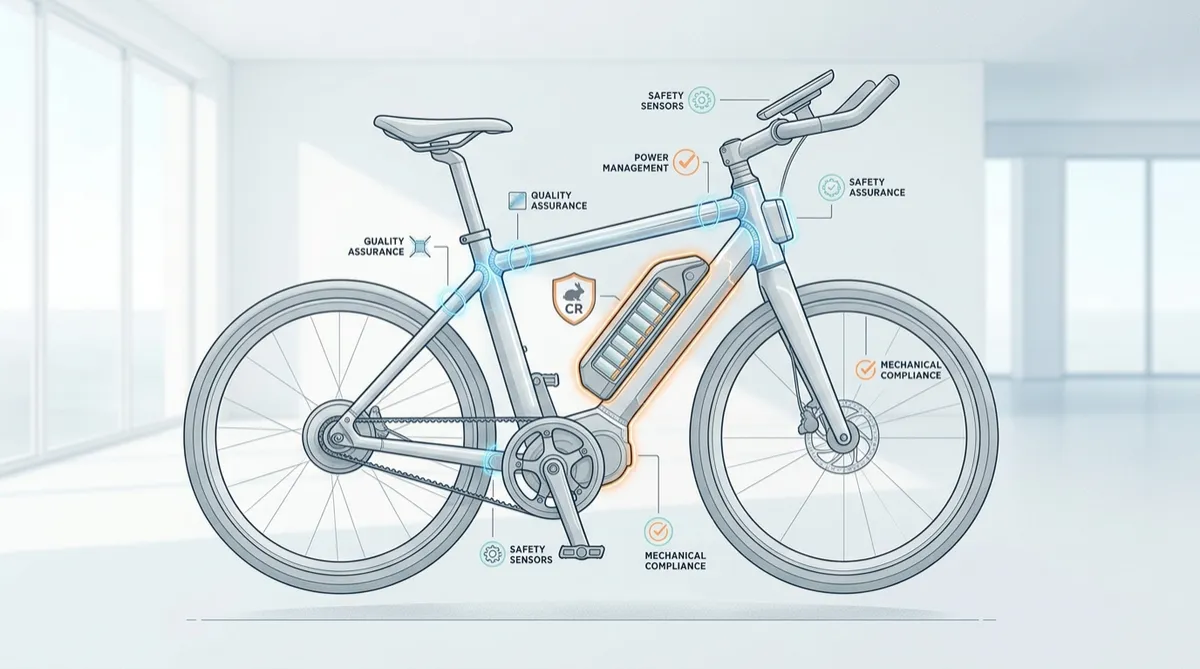
Fitness products sit at a dangerous intersection: heavy moving parts, high mechanical loads, batteries, and wireless electronics, often built for people exercising alone at home. Founders frequently underestimate how many overlapping certifications apply (ASTM, UL, FCC, and sometimes FDA), how weld and material choices determine whether a frame survives years of loading, how batteries and connectivity add a second compliance track, and how skipping early design validation leads to expensive late-stage redesigns. Getting these four decisions right before tooling is committed protects your launch date, your capital, and your customers.
Picture a founder six weeks from shipping a connected rowing machine. The prototype works beautifully on the bench. Then a supplier asks which UL standard applies to the console, a retailer's compliance team asks for an FCC ID, and a structural engineer flags that the seat rail weld pattern hasn't been fatigue-tested. Suddenly the "final" product isn't final at all.
This scenario plays out constantly in the fitness category, and the stakes are real. Recent recall data shows exercise equipment has produced some of the largest consumer product recalls in the country. A 2025 recall of adjustable dumbbells involved nearly four million units after weight plates detached during use, and a popular connected rowing machine was recalled for a fire hazard tied to its console.
This article walks through four decisions that separate fitness products that launch smoothly from those that stall, get redesigned, or get pulled from shelves: navigating the certification maze, choosing materials and joining methods that survive real-world loading, managing the added risk that comes with batteries and connectivity, and using design validation to catch problems before they become recalls. Whether you're developing a mechanical assembly like a rowing frame, a molded housing for a fitness tracker, or a full connected exercise machine, these choices apply.
The Certification Maze Nobody Warns You About
Most founders assume fitness equipment needs one safety certification. In reality, the requirements branch based on what the product does, whether it plugs in, whether it measures anything, and whether it's marketed for medical use.
Mechanical fitness equipment, from resistance benches to stationary bikes, is generally evaluated against ASTM International's fitness equipment standards. These specifications establish parameters for the design and manufacture of fitness equipment, covering stability, support, edges, corners, tube ends, and guarding requirements for squeeze, shear, and crush points, handgrips, and load-transmitting components like ropes, belts, and chains. Separate ASTM specifications exist for stationary bikes, selectorized strength equipment, and inclusive-use designs, so a single "fitness standard" rarely covers an entire product line.
Once electricity enters the picture, a different set of rules applies. UL standards commonly applied to fitness products include UL 961 for electric hobby and sports equipment, UL 1647 for motor-operated massage and exercise machines, and UL 62368-1 for audio/video and information technology equipment. If the product also measures something like heart rate or resistance load, it can cross into a different regulatory lane entirely. Federal regulation 21 CFR 890 sets requirements for exercise equipment and devices intended for medical purposes, including equipment with measuring instrumentation such as a pulse rate monitor.
Here's the part that catches founders off guard: certification isn't just about passing a lab test once. Regardless of which standard applies, products generally need to be designed so they won't hurt people or start fires even when something goes wrong, which means proper electrical insulation, fire-resistant materials, and designs that fail safely when components break or users misuse the product. That "fail safely" requirement is a design decision, not a paperwork step, and it needs to happen before tooling is cut.
Quick Answer: A single fitness product may need to address ASTM structural standards, applicable electrical safety certification, FCC authorization for wireless features, and FDA requirements if it is intended for medical use or makes medical claims.
Does your product combine mechanical, electrical, and connected features? Rabbit Product Design can help you map which standards apply before you commit to tooling.
Where Frames Really Fail: Welds, Materials, and Fatigue
The visible problem in fitness equipment recalls is almost always the same: a seat drops, a handlebar gives way, a frame collapses. Look at the recall history and a pattern emerges quickly. A 1996 recall of 21,500 exercise machines was issued because welds developed cracks under the seat. A similar 2003 recall affected roughly 9,500 units after handlebar welds failed under the seat. A third recall pulled 300,000 cross trainers for the same underlying issue.
The deeper technical cause is fatigue, not a one-time overload. Exercise equipment gets loaded and unloaded thousands of times, and welded joints are where that repeated stress concentrates. Research on welded structures shows that material grade, weld quality, and fabrication procedure have a major impact on the long-term structural durability of welded assemblies. A weld that looks fine on day one can still be the weak point three years and fifty thousand repetitions later.
The practical consequence is that frame design can't be finalized on visual inspection alone. Reputable fitness equipment manufacturers build in structured checkpoints for exactly this reason. A documented quality control process for tube-based fitness equipment typically includes:
Material and tube specification verification before cutting
Cutting accuracy and frame fabrication review
Weld inspection and grinding checks
Pre-assembly fit verification before coating
Function testing, including load and durability checks
Cable or wire rope fatigue testing where applicable
Packaging and shipment documentation
The decision this forces is upstream: choose your material and joining method with fatigue life in mind, not just static strength. Tube wall thickness, weld geometry, and even whether a joint is welded, bolted, or brazed all change how a frame ages under real use. For plastic housings and non-structural components, the calculus is different. Sheet metal manufacturing can be automated and parts produced directly from CAD models, and while setup for the first piece can be costly, the price per piece drops quickly as volume increases, which matters when deciding between sheet metal brackets and machined or molded alternatives for a fitness product's housing or hardware.
Connected Fitness Adds a Second Layer of Risk
Add a screen, a Bluetooth heart rate strap, or a rechargeable battery, and the compliance picture doubles in complexity. This is the information gap that trips up teams building IoT-enabled fitness products for the first time.
Wireless connectivity triggers its own approval process, separate from mechanical safety. If a device is covered by FCC rules, it must go through the FCC's equipment authorization process before it can be imported, marketed, or sold in the US, and most intentional radiators, including Bluetooth and Wi-Fi devices, require certification. The FCC has specifically acknowledged fitness as a growing wearable category.
What happens with the battery matters just as much. UL 1642 ensures the safety of lithium cells themselves, UL 2054 ensures the safety of the whole battery pack, and UN 38.3 ensures the battery is safe during shipping and transport. Most fitness electronics with rechargeable batteries need to satisfy more than one of these simultaneously, and the testing itself is demanding.
Regulatory framing also depends on what the product claims to do. Sports and fitness wearables that make no medical claims are typically subject to general product requirements and radio-equipment rules, while medical wearables such as ECG monitors can fall under full medical device regulation. That distinction can change your entire development timeline, so it needs to be settled at the concept stage, not after your app team has built heart-rate tracking into the product.
Physical safety hazards don't disappear just because a product has a screen, either. Product safety considerations for wearables include addressing hazards such as button battery ingestion through secure design and clear warnings, an issue that falls under CPSC's jurisdiction. And mechanical failure modes still apply even to "smart" equipment. A wall-mounted, digitally connected strength system was recalled in late 2025 specifically because of its locking mechanism. Adding electronics doesn't reduce your mechanical obligations. It adds a parallel set of new ones.
Building a connected fitness product with batteries or wireless features? Rabbit Product Design can help you plan a design that anticipates both the mechanical and electronic compliance path.
Why Prototyping and DFM Decide Your Launch Date
The visible problem most founders experience isn't a recall. It's a delay: tooling gets built, then a manufacturability issue forces a redesign, and a launch date slips by months while capital sits tied up in revised molds and welded fixtures.
The deeper cause is usually a skipped step: manufacturability wasn't checked early enough against the actual production process. Early feasibility review exists precisely to catch this before tooling commitment. Automated Design for Manufacturing (DFM) analysis during concepting and ideation helps assess feasibility before a design moves toward tooling, with rapid prototyping and consultative design offering a way to validate designs at the product development stage. Skipping that review doesn't save time; it just moves the cost to a more expensive point later, after tooling exists and changes require rework rather than a CAD edit.
The consequence compounds when quality assurance is treated as a final checkpoint rather than a built-in process. A company that wastes resources, creates scrap, and works inefficiently to produce sub-optimal products is at a disadvantage to competitors producing similar goods faster, with less scrap, at a higher level of quality. Fitness products are particularly unforgiving here because a warehouse defect that would be a minor inconvenience in a toy becomes a safety incident in a 400-pound leverage gym.
For newer product categories, this is also where production-grade prototyping can shorten the path. Production-grade 3D printing sometimes lets a part perform as well as, or better than, a conventionally produced part, cost-effectively enough that downstream tooling investment is delayed or even unnecessary, for lower-volume runs or design validation builds, which matters for founders trying to test a design in the market before committing to full-scale metal tooling.
The decision this forces is sequencing: manufacturability review, prototype validation, and durability testing need to happen before tooling, not in parallel with it. That order is what keeps a launch date real instead of aspirational.
Not sure whether your fitness product design is ready for tooling and production? Rabbit Product Design can help you evaluate the next step before you commit capital.
Bringing It Together
Every recall and delay described above traces back to a decision made, or skipped, early in development. A practical framework looks like this:
Identify every applicable standard (ASTM, UL, FCC, FDA) based on what your product does, not just what category it sits in
Choose materials and joining methods with fatigue life in mind, not just day-one strength
Build in structured QC checkpoints for welds, fasteners, and moving parts before finishing and assembly
Treat batteries and wireless features as a separate compliance track that starts at the concept stage
Run manufacturability review and prototype validation before tooling is committed, not after
None of these decisions are exotic. They are sequencing problems: doing the right analysis at the right moment instead of discovering the gap after money has already been spent. Founders who treat certification, materials, electronics, and validation as parallel tracks from day one tend to launch on schedule. Founders who treat them as afterthoughts tend to meet them anyway, usually in a much more expensive form.
Schedule a Free Strategy Call Click Here
References
ASTM International — F2276 Standard Specification for Fitness Equipment
ASTM International — Sports Standards and Recreation Standards
Newsweek — Product Recalls Are on the Rise, Top Causes Revealed
U.S. Consumer Product Safety Commission — CPSC, DCD Incorporated Announce Recall of Exercisers
U.S. Consumer Product Safety Commission — CPSC and CSA Announce Exercise Machine Recall
The Healthy — 44,000 Popular At-Home Fitness Machines Were Just Recalled Nationwide for Fire Hazard
ComplianceGate — Fitness Product Regulations in the United States: An Overview
Product Safety Inc. — What Does My Product Need to Meet UL Standards