

Why Beauty Devices Fail Safety Tests
Hidden Risks Before Mass Production
Executive Summary: Beauty, salon, and personal care products carry risks that go far beyond formulation. Device housings molded from undocumented recycled plastic, inconsistent global cosmetics regulations, battery and heating failures, and inadequate moisture protection are among the most common reasons physical beauty products get recalled, rejected by retailers, or redesigned after launch. This article walks through the material, regulatory, electrical, and environmental decisions founders need to lock down before tooling starts, so the product that reaches shelves is the one that was actually engineered to survive daily use.
Picture a founder holding the first production sample of a sleek, rechargeable facial massager. The housing looks perfect. The battery charges. The silicone feels right in the hand. Then a retailer's compliance team asks for test reports on the plastic resin, the battery pack, and the water-resistance rating, and the launch date quietly slides by three months.
This scenario repeats across the beauty and personal care industry more often than most founders expect. A molded enclosure, a heating element, a rechargeable battery, or a simple snap-fit joint can each become the reason a product stalls in testing, gets flagged by a retailer, or worse, gets recalled after it's already in customers' homes.
This article focuses on the physical engineering side of beauty and personal care products, the devices, tools, dispensers, and packaging that founders design, mold, and manufacture, rather than the liquid formulations inside them. Understanding these four decision points can save months of rework and protect both your customers and your capital:
How recycled plastic sourcing can quietly introduce banned chemicals into a device housing
Why a product compliant in one country can be illegal in another
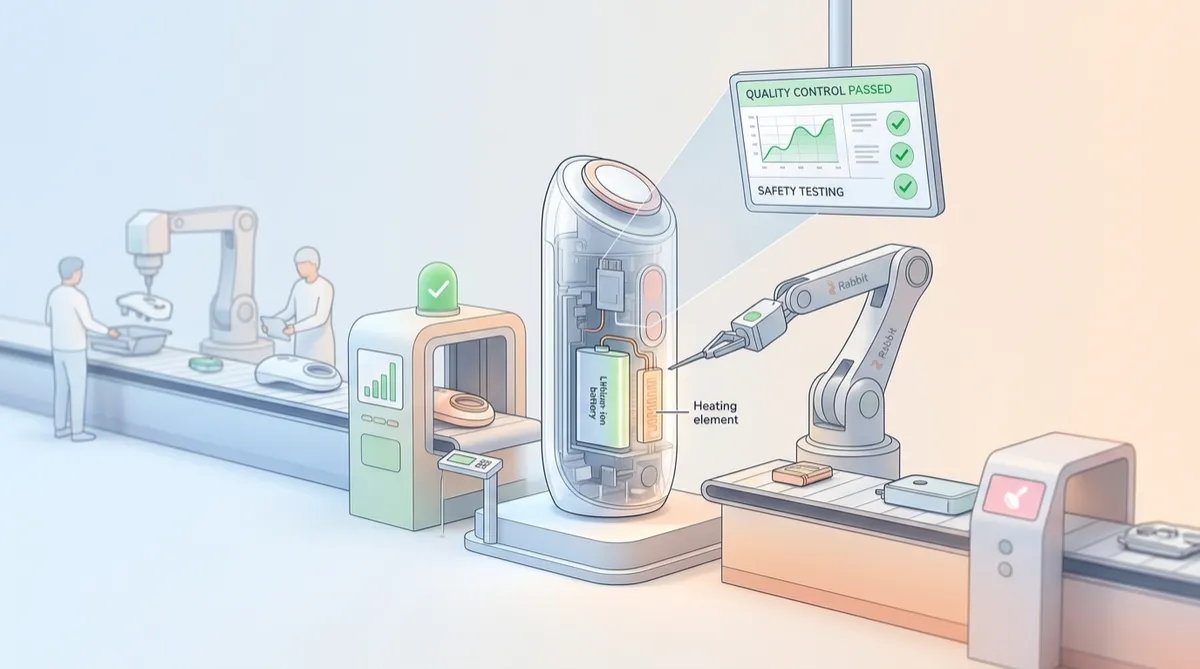
What causes heated and battery-powered beauty tools to fail safety testing
Why a bathroom-ready label requires more than a splash-resistant seal
The Plastic You Choose Can Quietly Sabotage Your Launch
Founders usually think about plastic in terms of color, texture, and cost. Few think about where the resin actually came from. That gap in knowledge has become an expensive one.
Recent investigations into black plastic consumer goods found that recycled feedstock contaminated with flame retardants from electronic waste was showing up in products never meant to carry them. Black-colored plastic used in electronics is leaching flame retardants into kitchen utensils, toys, and food containers, apparently during the recycling of electronic waste. The most hazardous flame retardants found in these consumer products are the same ones used in electronic enclosures on televisions and other electronics. One tested item contained bromine levels in the thousands of parts per million, originating from recycled circuit-board housings rather than anything intended for personal care use.
This matters directly for beauty device manufacturers. According to an FDA spokesperson, recycled electronics are not considered a safe source of recycled material, because contaminants from recycled material may end up in the final product, or adjuvants in the recycled plastic may not comply with applicable regulations. As more processors incorporate recycled materials in response to customer demand or regulation, recyclers and converters need robust material traceability systems to ensure the reclaimed feedstock is actually appropriate for the intended application.
The same caution applies to packaging. Independent research found higher chemical migration in post-consumer recycled high-density polyethylene than in virgin plastic, though it confirmed safe use is possible with strict quality controls. That same research detected substances such as bisphenol A and a fragrance compound in recycled samples that were absent from virgin material, underscoring the importance of tight quality control over recycled content.
For a founder sourcing molded components, the decision isn't whether to use recycled content at all. Sustainability goals and retailer expectations often push toward recycled materials. The decision is whether your supplier can prove, with documentation, exactly where that resin came from and what it was tested for before it reached your mold.
Does your product rely on molded plastic components? Let's talk about material sourcing and documentation before tooling begins.
One Set of Rules Won't Get You Everywhere
A founder who clears domestic compliance often assumes the hard part is over. It usually isn't.
Under the Modernization of Cosmetics Regulation Act, facilities that manufacture or process cosmetics products for U.S. distribution must register with the FDA, and manufacturers must list each product with the agency, including its ingredients and where it is manufactured. Manufacturers must also maintain records of health-related adverse events for several years and report serious adverse events to the FDA within 15 days of learning about them.
Cross the Atlantic, and the entire philosophy changes. The EU framework operates on a precautionary principle, requiring a documented safety assessment before a product reaches the market, with the burden of demonstrating safety resting on the brand, whereas the FDA can act against unsafe products after they're already on the market, with no equivalent mandatory pre-market safety assessment. The scale of ingredient restriction reflects that difference directly: banned cosmetic ingredients differ wildly between regions, with the EU prohibiting more than 1,600 substances compared to about 11 restricted federally in the United States.
For founders planning international distribution, this creates concrete decisions, not just paperwork:
Which packaging materials and colorants are approved in every target market, not just your home market
Whether your product needs a designated regional responsible party for compliance
How adverse event reporting timelines differ by country
Whether labeling claims that pass in one jurisdiction trigger review in another
How recall authority and procedures differ if a defect surfaces after launch
None of this is formulation chemistry. It's product strategy, and it belongs in the earliest design conversations, not after tooling is cut.
When Heat, Power, and Human Skin Collide
A curling iron, hair straightener, or heated styling tool looks simple from the outside: a heating element, a housing, a cord or battery. The engineering underneath is not simple at all, and the consequences of getting it wrong land directly on a user's skin.
In late 2025, a manufacturer recalled hundreds of thousands of curling irons after reports that the barrel could detach mid-use. The hazard was straightforward: the barrel of the curling iron could snap and detach, posing a burn hazard to consumers. The firm had received 258 reports of the barrel detaching, including six minor burn injuries, before the recall was issued. This wasn't an isolated failure mode. A similar recall years earlier involved heated ceramic plates that could loosen and detach during use, posing a risk of burn injuries.
Both failures trace back to the same root cause: a mechanical joint near a heat source that wasn't engineered to withstand repeated thermal cycling and handling stress. The visible problem is a cracked barrel or a loose plate. The deeper cause is almost always a fastening or bonding method that looked adequate in a prototype but degraded under real-world heat and use.
The applicable safety standard exists precisely because this category of risk is well understood. The international safety standard for hair care appliances addresses electric appliances for the care of hair, including curling irons, hairdryers, and straighteners, rated up to 250 volts, covering both household and salon use. That standard exists specifically to guide the safe design, manufacture, and use of small electrical appliances in homes, salons, and light industry.
Battery-powered devices carry their own layer of risk. The relevant battery pack safety standard covers household and commercial battery packs, including lithium-ion and other rechargeable chemistries used in consumer electronics, and it is the primary certification pathway retailers and regulators recognize as evidence of baseline battery safety. That standard addresses pack-level safety including overcharge, over-discharge, short circuit, mechanical abuse, and environmental testing, — all scenarios a rechargeable facial device, trimmer, or massager will realistically encounter over its lifespan.
The decision for a founder here is not whether to test. It's whether testing happens during development, when a design flaw costs a revision, or after launch, when it costs a recall.
Working with heating elements or rechargeable batteries in your device? A short strategy session can help you identify what needs validation before production tooling is finalized.
Why Your Bathroom Gadget Needs More Than a Pretty Shell
Personal care devices live in one of the most hostile environments for electronics: a small, humid room full of running water, splashes, and condensation. Many founders treat water resistance as a marketing checkbox rather than an engineering requirement, and that assumption causes real problems later.
The Ingress Protection rating system categorizes electrical appliances by their ability to keep out foreign bodies such as dust and water, which matters most in bathroom electronics because it prevents water from entering the appliance and causing a dangerous malfunction. The first digit refers to protection against solid objects, while the second refers to protection against water, from general humidity to complete submersion.
Where a device will physically sit matters as much as the rating itself. A bathtub or shower interior is classified as Zone 0, where any electrical fixture must run on separated extra-low voltage and carry a minimum rating equivalent to full immersion protection, while the zone above a bath or shower to roughly 2.25 meters calls for a somewhat lower but still substantial rating. A splash-resistant rating that's adequate for a countertop appliance may be entirely inadequate for a device meant to be held in a running shower.
Consumer electronics brands have already learned this the hard way in adjacent categories. Ratings that protect only against splashing water, without dust testing, are common in bathroom speakers and similar consumer electronics, but that level of protection is not interchangeable with ratings meant for devices used under direct water jets or temporary immersion.
For a founder designing a shower-safe trimmer, an electric facial cleansing brush, or a rechargeable toothbrush-style device, the practical checklist includes:
Defining exactly where the device will be used, countertop, sink-side, or in-shower
Selecting the IP rating that matches that use case, not just a convenient certification already on hand
Verifying seal and gasket design holds up after repeated charging-dock removal and reinsertion
Confirming charging contacts and ports are rated for the same exposure as the housing
Testing after simulated aging, since seals and gaskets degrade with heat cycling and use
A rating printed on packaging means little if the physical design behind it was never validated for the device's real environment.
Bringing the Decisions Together
Every section above points to the same underlying lesson: the physical product around a beauty or personal care item carries its own regulatory, material, and engineering risk, separate from whatever is inside the bottle, jar, or reservoir. Founders who treat enclosure material, electrical safety, moisture protection, and regulatory scope as afterthoughts tend to discover the gaps only after tooling is cut and inventory is on a cargo ship.
Before committing to production, it's worth evaluating:
Where your molded resin actually comes from, and whether that supply chain can be documented
Which markets you intend to sell into, and what each one legally requires
Whether heating elements, battery packs, and mechanical joints have been tested against the recognized safety standards for your device category
Whether your water-resistance rating actually matches where and how the product will be used
And other relevant manufacturability and sourcing considerations specific to your design
None of these decisions require slowing down a good idea. They require sequencing the right conversations before, rather than after, a mold is built.
References
Personal Care Products Council — Modernization Of Cosmetics Regulation Act (MoCRA)
Care Europe — EU vs. FDA Cosmetic Regulations — Key Differences That Affect Product Strategy
Scanveer — Banned Cosmetic Ingredients: The US vs EU Gap Explained
iTeh Standards — IEC 60335-2-23:2026 Safety for Hair Care Electrical Appliances
Battery Design — UL 2054 Standard for Safety — Household and Commercial Batteries
Packaging Insights — Research highlights safety trade-offs in PCR materials for personal care
Lumistrips — IP waterproof ratings explained, recommended levels for the bathroom
Battery Testing Machine — The Ultimate Guide to IP Waterproof Ratings 2026