
The Prototype Testing Trap
Why Early Validation Saves Millions
Executive Summary
Many product teams assume that if a prototype survives testing, the production version will too. That assumption is often wrong, and it's one of the most expensive mistakes in product development. This article explains why prototype material and process choice can distort test results, which safety certifications are not optional for toys, electronics, and connected products, when virtual simulation can responsibly replace physical testing, and what a skipped validation step really costs once tooling is cut and products are in customers' hands. The throughline: validation decisions made early are cheap, and the same decisions made late can cost millions.
A founder once showed us a 3D-printed enclosure that had passed every drop test on the bench. Six months later, the injection-molded production version cracked at the same stress point during a much milder test. Nothing about the design had changed. What changed was the material process underneath it, and nobody had accounted for that difference until the tooling was already cut.
This happens more often than most teams expect, and it's rarely discussed openly because admitting it means admitting a costly redesign. If you're building a physical product, whether it's a kitchen gadget, a connected sensor, a toy, or a piece of sports equipment, the way you test it, what you test it against, and when you test it will shape your budget, your launch date, and your relationship with retailers and regulators.
This article walks through four decisions that determine whether testing protects your product or quietly misleads you:
Whether your prototype is actually representative of what you'll manufacture
Which certifications are mandatory for your product category, not optional
When computer simulation can responsibly stand in for a physical test lab
What a skipped or rushed validation step actually costs once a product ships
Understanding these decisions early means fewer surprises after tooling investment, fewer disappointed retail partners, and a much steadier path from concept to shelf.
Why Your Prototype Might Be Lying to You
A prototype's job is to answer a question. But if the prototype is made with a different process than your final product, it may be answering the wrong question entirely, and answering it convincingly.
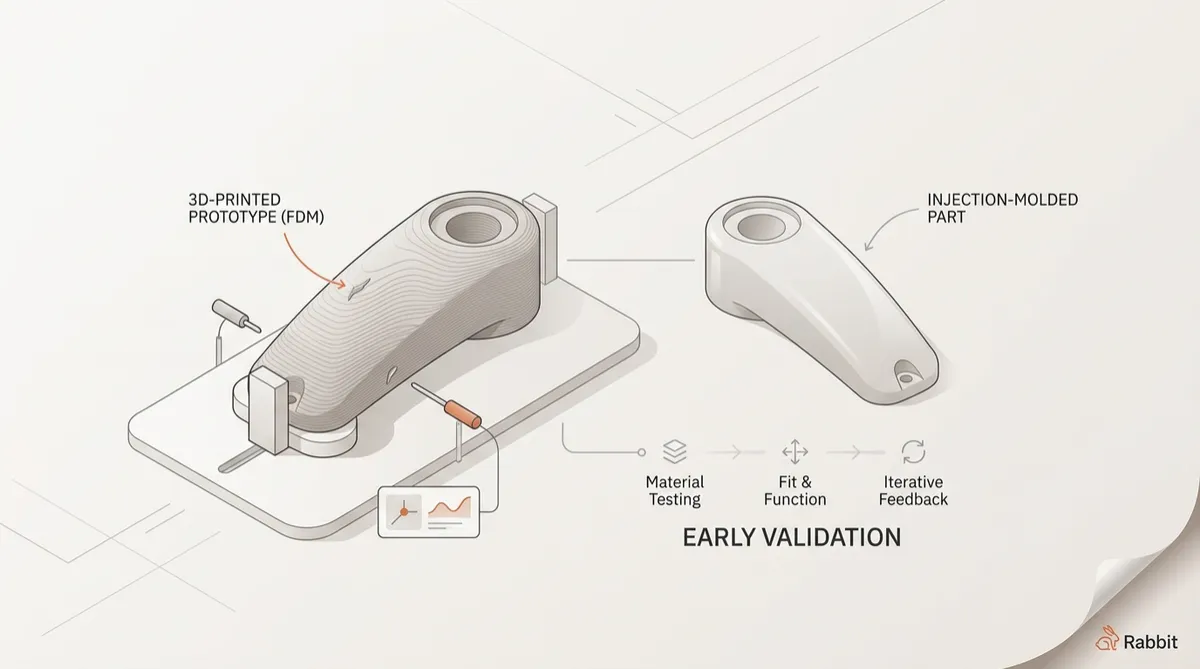
Three-dimensional printing is the fastest, cheapest way to hold a design in your hands, which is exactly why it's so widely used early in development. The trouble starts when teams use that same print to validate decisions meant for the finished, injection-molded or machined part. Engineers who specialize in prototyping note that printed parts and production parts differ in their surface properties, their tolerances, and their strength properties. A dimensional check on a printed part is a test of 3D printed parts' tolerances not production tolerances, and when compared with injection molding, 3D printed parts tend to have substantially looser tolerances.
Strength tells an even sharper story. Research comparing printed and molded parts made from the same plastic found printed samples reaching 60% of the strength noted for injection molded samples, with the least resistant samples oriented vertically to the worktable having only 33% strength of the injection molded parts. Depending on print orientation and settings, some samples came close to matching molded strength, while others fell far short, which means a part can look identical and behave completely differently depending on how it was built. A separate industry comparison summarizes the gap plainly: injection molded parts typically exhibit superior mechanical properties, compared with 3D-printed equivalents.
None of this means prototypes are useless. It means the question you ask of a prototype has to match the process that made it. Tensile testing standards exist for exactly this reason. Protolabs, a manufacturing partner that runs mechanical testing on printed parts, follows the long-established Standard Test Method for Tensile Properties of Plastics and notes that build orientation plays a role in mechanical property outputs, which is why test bars are printed and reported in specific planes depending on the process.
Key takeaway: Use early prototypes to validate form, fit, and basic function. Reserve strength, tolerance, and durability validation for parts made with your intended production process and material, or clearly document the gap between the two.
Does your product combine multiple materials or processes? Let's talk about which prototype stage actually answers your toughest engineering questions.
The Certifications You Can't Skip
Plenty of founders believe that if their product works reliably on the bench, it's ready to sell. That belief overlooks an entire category of testing that has nothing to do with whether the product works, and everything to do with whether it's legal to sell.
If your product is a toy, or anything "designed or intended primarily for children 12 years of age or younger," the Consumer Product Safety Commission requires third-party testing, full stop. According to the CPSC, third-party testing and certification are required for toys designed or intended primarily for children 12 and under, and once you have identified the applicable requirements for your product, you must use a CPSC-accepted, third-party laboratory to perform testing. The governing standard, ASTM F963, covers far more than choking hazards:
Small parts and sharp edges or points
Flammability and ignition resistance
Heavy metal migration across eight elements
Phthalate content in plastics and coatings
Electrical and thermal hazards for powered toys
Acoustic limits to prevent hearing damage
Age grading and warning label requirements
Testing a single toy model through an accredited lab typically runs around $1,200, depending on test scope and lab. That's a modest line item compared to discovering a compliance gap after a shipping container is already at port.
Electronics face a parallel, separate set of requirements. Underwriters Laboratories (UL) certification isn't legally mandatory in most cases, but it functions as one in practice. Retailers routinely require it before they'll stock a product, and as one compliance guide puts it, UL is actually NOT mandatory, however, most retailers will demand UL certification before they buy products from manufacturers and not having the certification can open you up to litigation if things go wrong. For products with lithium-ion batteries or AC power connections, UL's primary concern is blunt: this certification ensures that your product doesn't start an electrical fire, or cause other safety issues.
Connected and wireless products add a third layer entirely. Any device using Wi-Fi, Bluetooth, Zigbee, or similar protocols falls under Federal Communications Commission (FCC) Part 15 rules, and as one engineering resource explains, FCC testing for Product Certification can be broken into two parts: General Emissions testing and Intentional Radiation testing. Virtually every electronic product needs to undergo General Emissions testing. That baseline testing typically costs $1,000 to $5,000 when performed by an accredited laboratory, though products built around a pre-certified wireless module can sometimes skip the more involved intentional radiation portion.
Quick answer: Toys need CPSC-accepted third-party ASTM F963 testing. AC-powered or battery electronics typically need UL safety evaluation. Wireless or connected products need FCC emissions testing. These requirements stack if your product fits more than one category.
Can Simulation Replace the Physical Test Lab?
Ten years ago, physical prototypes were the final word on whether a design worked. That's changed, and the shift has real implications for how much testing budget you need and when you need it.
The clearest public signal of this shift came from the automotive industry. In 2018, General Motors' CEO announced a plan that reshaped how the industry thinks about validation: in 2018, when General Motors CEO Mary Barra unveiled GM's plan to transition to 100% digital testing by 2025 and phase out physical testing entirely, the announcement effectively ratified both a technological and a cultural change for the industry. That move reflected something that had been building for years, driven by the rising cost of physical testing and delays in product launches, coupled with advancements in computing power.
The economics behind that shift are measurable. Research on simulation-driven development found that moving analysis earlier in the design process reduces labor and prototype cost by 26 to 30%, and that upfront simulation reduces testing and quality assurance costs by 19 to 33%. A separate study cited by the same source found that the National Institute of Standards and Technology determined simulation software can reduce the cost of physical prototypes by up to 50%.
But simulation isn't a wholesale replacement, and treating it that way is its own risk. Even industries furthest down this path still pair digital work with physical confirmation. Autonomous vehicle development, for instance, relies on hardware-in-the-loop testing specifically because both safety of the intended function (SOTIF) and safety first for automated driving (SAFAD) requirements emphasize the importance of safety by validation for automated vehicles, which is first validated during HiL testing and then, for selected use cases, during actual on-road testing. And as simulation has taken on a bigger share of the validation burden, companies have had to build new discipline around it, since reduced reliance on physical testing means organizations now place greater emphasis on simulation result reviews and formal signoffs to ensure confidence in design decisions.
For most consumer product teams, the practical decision looks like this:
Use simulation early to explore geometry, material thickness, and stress concentrations before committing to tooling
Reserve physical testing for regulatory-mandated requirements that must come from an accredited lab regardless of simulation confidence
Treat simulation results as a way to narrow down which physical tests matter most, not as a replacement for them
Build in a formal review step before trusting a simulation result the way you'd trust a lab report
Not sure whether your current design is ready for physical testing or needs another simulation pass first? Rabbit Product Design can help you map out the right sequence.
What a Skipped Test Really Costs
The cost of a test that gets rushed, skipped, or run on the wrong sample doesn't disappear. It just moves downstream, and it grows as it moves.
Engineers sometimes describe this with a simple heuristic: a defect found at the design stage costs a fraction of what the same defect costs if it's caught after the product ships. One analysis of recall economics frames it this way: a defect costs roughly one unit to resolve at the design stage, ten units at final assembly, and one hundred units after shipment. That multiplier is why validation that feels slow in the moment is almost always the cheaper path.
The numbers behind an actual recall make the stakes concrete. Direct recall costs, covering retrieval, disposal, and customer response, average close to US100 million. That figure is also incomplete. A more detailed breakdown of recall economics found that roughly 35% of total recall cost is the direct recall operation, 49% is business interruption, and 16% is product rehabilitation, communications, and consulting, meaning the headline number most teams plan around is less than half the real bill. Among larger manufacturers surveyed recently, 59% put each recall between $10 million and $49.9 million.
The hidden costs behind these figures are familiar to anyone who has lived through a redesign after tooling:
Steel tooling that can't be modified without scrapping it
Production schedules pushed back while fixes are engineered
Retail partners who lose confidence and delay reorders
Engineering teams pulled off new projects to fight fires
Inventory already in transit that may need to be reworked or destroyed
Customer trust that takes far longer to rebuild than the product itself
None of this argues for testing everything exhaustively regardless of cost. It argues for sequencing validation so the expensive, hard-to-reverse decisions, like steel tooling, happen after the cheap, easy-to-reverse testing, like simulation and early prototypes, has already caught the obvious problems.
Bringing It Together
Good validation isn't about running more tests. It's about running the right test, on the right sample, at the right moment, against the right standard. Four decisions carry the most weight:
Match your prototype's material and process to the question you're asking it. A printed part can answer fit and function questions long before it can answer strength and tolerance questions meant for production parts.
Identify every mandatory certification your product category triggers, toy safety, electrical safety, wireless emissions, before you finalize a design, not after.
Use simulation to narrow your physical testing scope and catch problems early, but keep regulatory-mandated physical testing in an accredited lab where it belongs.
Treat the cost of validation as insurance against the much larger cost of a late-stage fix, a delayed launch, or a recall.
None of these decisions have to be made alone. The teams that navigate them well usually have an engineering partner asking the uncomfortable questions early, when they're still cheap to answer.
References
QualityInspection.org — UL Certification: Does Our Product Need It?
Predictable Designs — Understanding Certifications for Electronic Hardware Products
Embedded Computing Design — New to wireless? Understand FCC certification for IoT products
Lumafield — The Real Cost of a Product Recall and How to Prevent One
Syspro — What Does a Product Recall Cost a Manufacturer, and What Stops the Next One?
SimOps — SimOps 101: How Simulation Reduces Product Development Costs
Ultimaker — 3D Printing vs Injection Molding: Is Additive Manufacturing Better?
ResearchGate — Are We Able to Print Components as Strong as Injection Molded?
Ansys — Ansys AVxcelerate Sensors Leverages NI-RDMA for HiL Testing