

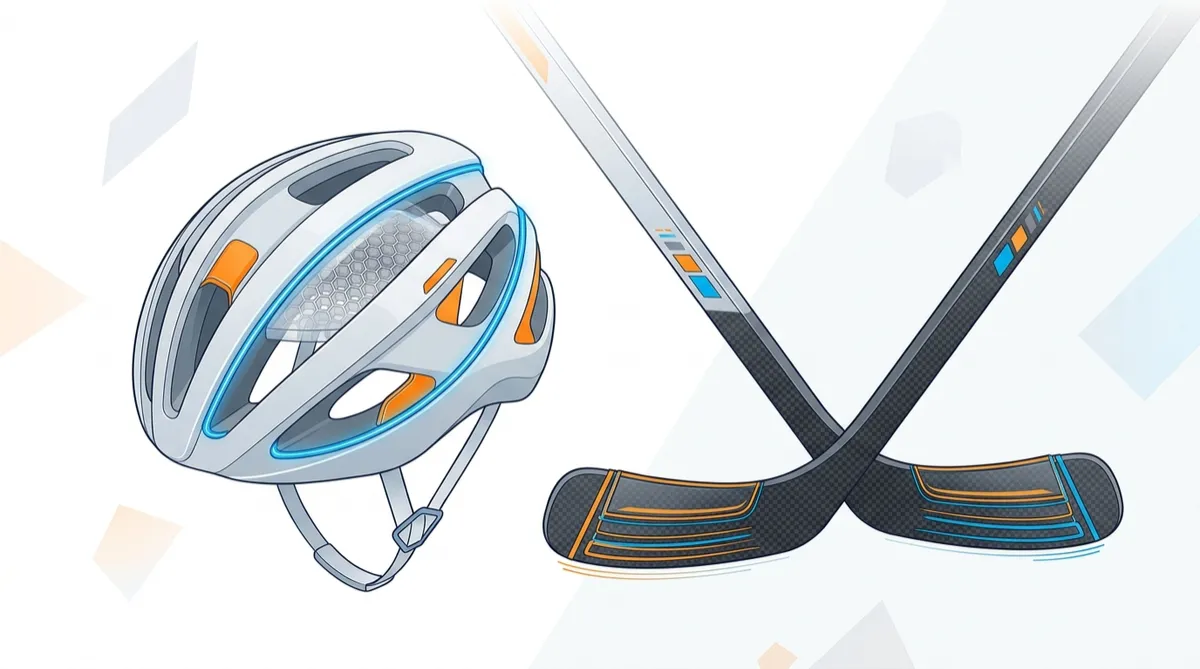
The Hidden Risks in Sports Gear
Costly Mistakes Before Your Launch
Executive Summary
Sports and athletic products look simple from the outside, but four decisions quietly determine whether a product succeeds or stalls: material selection, safety certification, electronics integration, and tooling strategy. Choosing carbon fiber versus glass-reinforced plastic changes cost and durability outcomes. Certification bodies like NOCSAE and the Consumer Product Safety Commission (CPSC) can block a launch if compliance planning starts too late. Adding sensors introduces battery and packaging trade-offs most teams underestimate. Finally, jumping straight to steel tooling before validating a design can waste tens of thousands of dollars. Read on for the details behind each decision.
Introduction
A founder spends eight months perfecting a padded wrist guard, commits to a production mold, and then learns during third-party testing that the shell cracks under an impact load the certifying body requires. The tooling is already cut. The launch date slips by months, and the capital tied up in that mold can't be recovered.
This kind of story repeats across the sports and athletic products industry more often than most founders expect. The stakes are real: a molded helmet shell, a wearable heart-rate strap, a carbon fiber hockey stick, or an injection-molded fitness accessory all carry decisions that are difficult and expensive to undo once manufacturing begins.
This article walks through four decisions that shape cost, risk, and manufacturability for anyone developing sports or athletic equipment:
How material choice affects strength, weight, and long-term durability
Why safety certification planning needs to start before the design is finalized
What adding sensors or connectivity really costs in engineering complexity
How to choose the right tooling path without overspending or under-preparing
Understanding these four areas early can mean the difference between a smooth path to market and a costly redesign after tooling is already committed.
Why the Right Material Can Make or Break Your Gear
Most teams assume a strong-looking prototype material will perform the same way at scale. It often doesn't. A part that survives hand-testing in a workshop can behave very differently after thousands of injection-molding cycles or repeated impact in the field, and the material decision interacts directly with cost, weight, and certification outcomes.
Engineering plastics remain the default for many sports products because they allow complex geometries at a manageable cost. But when a product needs to be both light and strong, reinforced composites change the equation. Carbon fiber-reinforced thermoplastics are known for their superior strength-to-weight ratio, high stiffness, and excellent fatigue resistance, and are prevalent in aerospace, automotive, and sporting goods industries. Long and short fiber reinforced thermoplastics are well suited for applications requiring high strength-to-weight ratios as well as complex part geometries, including sporting goods.
This isn't theoretical. Equipment makers in hockey and lacrosse have already moved toward continuous carbon fiber injection processes specifically to make protective gear stronger without adding bulk, a shift aimed at improving durability for athletes without compromising comfort. Continuous fiber reinforced thermoplastics are used in high-performance bicycles, ski poles, tennis rackets, and other sports equipment because of their combination of lightness and strength.
The trade-off is cost and sourcing complexity. Composite processing generally requires specialized equipment and supplier relationships that plastics or metal don't. Before committing to a material, it helps to map out the realistic options:
Standard engineering plastics (ABS, nylon, polypropylene) for cost-effective, moldable geometries
Glass-fiber reinforced plastics for added stiffness at a moderate cost increase
Continuous carbon fiber composites for maximum strength-to-weight ratio in premium products
Aluminum or steel for predictable mechanical properties in load-bearing mechanisms
Soft goods and elastomers for comfort, grip, and skin contact surfaces
Each option changes tooling requirements, supplier lead times, and the testing a product will need to pass later.
Does your product combine composite, plastic, and metal components? Let's talk about your material strategy before you commit to tooling.
The Certification Maze That Catches Founders Off Guard
Many teams treat safety testing as a final checkbox rather than a design input. That assumption gets expensive. Athletic equipment that touches player safety, especially head protection, falls under specific performance standards, and passing an internal durability test is not the same as meeting the standard that retailers, leagues, and insurers actually require.
Helmet and protective gear makers work within standards maintained by the National Operating Committee on Standards for Athletic Equipment. NOCSAE sets performance and test standards for athletic equipment but does not itself certify or approve equipment; currently, the Safety Equipment Institute oversees certification of athletic gear.
References
NOCSAE - National Operating Committee on Standards for Athletic Equipment
Consumer Product Safety Commission (CPSC)