

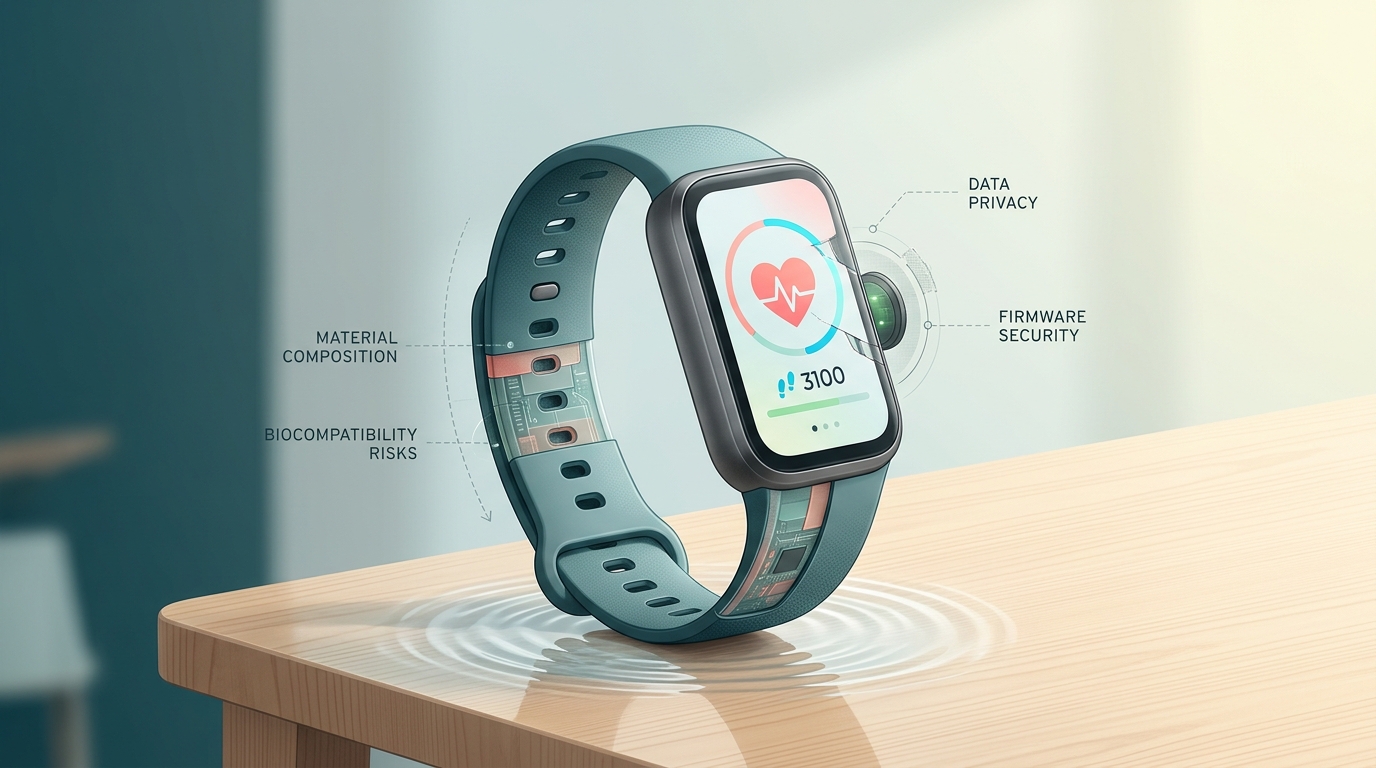
The Hidden Risks in Fitness Design
Decisions That Make or Break Launches
Executive Summary: Fitness products — wearables, trackers, smart equipment, and training gear — face four decision points that quietly determine whether a launch succeeds or stalls. Choosing the wrong manufacturing process at the wrong volume can tie up tens of thousands of dollars in tooling. Overlooking skin-contact material requirements can trigger late redesigns. Picking the wrong water-resistance rating can mean either premature failure or wasted engineering. And underestimating certification timelines for wireless electronics and batteries can delay a launch by months. This article walks through each decision with the technical reasoning behind it, so you can plan sourcing, budget, and timeline with fewer surprises.
Picture a founder holding a working prototype of a fitness tracker. It survived a sweaty gym session, synced to a phone, and looks almost ready to sell. Then the questions start arriving from a contract manufacturer: What's your production volume? What material is touching the skin? What IP rating are you claiming? Has the battery passed transport testing? Each question represents a decision that should have been made months earlier, and each one can add weeks or dollars to the path to market.
This matters because fitness products sit at an unusually demanding intersection. They're worn against skin, exposed to sweat and sometimes rain, packed with batteries and wireless radios, and often expected to survive years of daily abuse — all while competing on price in a crowded consumer market. A molded enclosure for a heart-rate strap, a CNC-machined housing for a smartwatch sensor, or a strength-training bench frame all carry different manufacturing, material, and compliance requirements, and getting any one of them wrong tends to surface late, when it's most expensive to fix.
This article walks through four decisions that founders, inventors, and product teams building fitness electronics and equipment need to get right early: how to choose a manufacturing process for the actual volume you'll need, how to select materials that are safe for sustained skin contact, how much water resistance your product genuinely needs, and how to budget time for the certifications that stand between a finished design and a legal product launch.
Schedule a Free Strategy Call Click Here
Choosing a Manufacturing Process Before You're Forced To
Many first-time hardware teams pick a manufacturing process based on whatever made their prototype, not on what their actual production volume requires. That gap is where budgets get blown.
Quick Answer: Additive manufacturing (3D printing) tends to win on cost and speed below roughly a few hundred to a few thousand units. Injection molding wins above that range, once tooling costs are spread across enough parts. The exact crossover depends on part size, complexity, and material.
The historical rule of thumb placed the break-even point between traditional and additive manufacturing near quantities of 10 to 100, though new advances and technologies are starting to push this range closer to 100 to 1,000 or higher in some cases. Independent cost analyses echo this: one widely cited comparison found that 3D printing costs 85% less than injection molding at 1,000 parts, and remains the more cost-effective solution for up to roughly 13,050 parts, depending on the part. Other analyses place the crossover lower, often in the 3,000–6,000 unit range for many plastic parts once tooling, tolerances, and finish requirements are factored in.
For fitness hardware specifically, this means:
A first production run of a few hundred wearable enclosures is almost always cheaper to 3D print than to tool for injection molding.
A strength-equipment bracket needed in the thousands will usually justify an injection-molding tool once volume clears the break-even point.
Complex geometries with many small features (like the housings in wearable sensors) can shift that break-even point higher, because tooling for complexity is expensive too.
There's a second layer to this decision: part consolidation. According to Protolabs, thick, simple cross sections may not add cost in traditional manufacturing, but they add significant cost in additive manufacturing by increasing build time, and can also raise the risk of warpage. The upside is real, though — Protolabs notes that an entire chassis for a drone can be printed as a single piece, lightweighted for optimal performance, with no assembly required, and that the footwear industry has applied the same logic to customized midsoles. Fitness wearables and training accessories can often benefit from the same consolidation logic, cutting both part count and assembly labor.
A practical path many teams use successfully: prototype and validate design with 3D printing, then transition to injection molding once volume numbers justify the tooling investment — a hybrid approach that avoids committing capital before the design is stable.
Not sure which process fits your current volume and part geometry? Let's talk about your prototype.
Schedule a Free Strategy Call Click Here
What Touches the Skin Matters More Than You Think
A wearable's enclosure can be mechanically perfect and still fail the product if the wrong plastic or metal touches skin for hours a day. This is the information gap that catches teams who come from a pure engineering background rather than a regulated-product background.
Any device with sustained skin contact needs to be evaluated against the risk framework in ISO 10993, the international standard for biological evaluation of medical devices. The standard explains that any device that comes into direct or indirect contact with the skin must be tested for biocompatibility, and classifies products like wearables as surface-contacting devices — ones that touch the skin, intact mucous membranes, or breached surfaces. This isn't automatically a full medical-device testing burden for a consumer fitness band, but it does mean material choice can't be an afterthought.
The scope of testing scales with how long and how deeply the material touches the body. As one standards summary puts it, ISO 10993-1 is risk-based: the required endpoints scale with the nature and duration of body contact, so a short-contact skin device needs far less evaluation than an implant or blood-contacting device. The U.S. Food and Drug Administration's own guidance reinforces this for the lowest-risk category, noting that materials pose very low biocompatibility risk when they have a documented history of safe use in similar skin-contact applications.
Schedule a Free Strategy Call Click Here
For a fitness wearable, this translates into practical sourcing decisions:
Confirm the datasheet for any skin-contacting plastic, silicone, or metal references prior safe use in similar skin-contact consumer products.
Expect more scrutiny for straps and bands worn continuously versus clip-on sensors used briefly.
Build in time for cytosensitivity or irritation testing if you're using a novel material blend, since these tests take weeks, not days.
Choose a material that's expected to stay in production for your product's full life, since switching materials mid-run can force you to repeat evaluation.
The Whoop sensor, a well-known fitness wearable, illustrates how tight these material and geometry constraints can get in practice. According to Protolabs, which worked with Whoop during its early years, the device's plastic components had demanding geometries, some pushing right up against the manufacturer's smallest machinable sizes for CNC parts. Small, skin-worn electronics routinely push manufacturing tolerances and material choices to their limits simultaneously — which is exactly why these two decisions can't be made independently of each other.
How Much Water Resistance Does Your Product Actually Need?
Teams often default to the highest water-resistance rating they can imagine, assuming more protection is always better. It isn't — and the gap between "enough" and "too much" has real cost consequences.
Water resistance for electronics is measured through the Ingress Protection (IP) code, defined in the international standard IEC 60529. The code uses two digits: the first describes protection against solid objects and dust, the second against water. For fitness products specifically, one product-design resource notes that a wearable likely needs some form of water resistance to accommodate light rain or sweat, so perhaps an IPX4 rating would be acceptable — far below the full-submersion ratings often marketed on sport watches.
That same resource warns against over-specifying: each increase in IP rating brings greater complexity — a simple gasket or tight mating surface might meet an IPX4 rating, but IPX5 will almost always require tighter gaskets, O-rings, or ultrasonic welding. Another comparison of wearable ratings notes that IPX4-rated splash protection from any direction is well suited to heavy sweat during high-intensity gym training and running in rain, while higher ratings are built for direct rinsing or submersion scenarios most gym and training wearables will never encounter.
That gap between IPX4 and IPX7/IPX8 isn't cosmetic. Each step up typically means:
Additional sealing hardware and gaskets, adding part cost and assembly steps.
Tighter tolerances on enclosure mating surfaces, which can affect moldability and tooling cost.
More rigorous (and expensive) qualification testing before launch.
Design constraints on button and port placement, since every opening is a potential leak path.
The decision, then, isn't "waterproof or not" — it's matching the rating to the real use case. A wrist-worn fitness tracker built for gym and running use rarely needs full submersion protection; a swim-tracking device does. Specifying the wrong one in either direction either invites field failures or burns budget on protection nobody needed.
The Certification Timeline Nobody Budgets For
The most common reason a finished-looking fitness product slips its launch date isn't engineering — it's compliance testing that nobody scheduled early enough.
Nearly every connected fitness product uses a wireless radio, and in the United States that triggers Federal Communications Commission (FCC) oversight. Industry compliance guidance is direct about this: wearables with wireless functionality require FCC authorization, handled through Certification, Supplier's Declaration of Conformity, or Verification, and most wearables with Bluetooth, ANT+, or Wi-Fi will need FCC Certification, which requires testing at an accredited laboratory. That testing isn't instant — accredited lab time and the certification process itself routinely add weeks to a launch schedule if it isn't planned for in advance.
Batteries add a second compliance track entirely separate from radio testing. Any fitness wearable or electronic training device with a lithium battery needs to clear UN 38.3, the United Nations transport-safety testing standard. As one battery-testing lab explains, nearly all lithium batteries are required to pass section 38.3 of the UN Manual of Tests and Criteria, and testing helps manufacturers avoid costly delays in getting their product to market. This applies broadly: compliance guidance lists consumer electronics with rechargeable batteries, electric toys, medical devices, hand tools, and small appliances, as products that routinely require this testing before they can ship internationally by air, sea, or road.
Mechanical fitness equipment carries its own, separate standards track. ASTM International publishes equipment-specific specifications, including ASTM F2276-23, the Standard Specification for Fitness Equipment, alongside standards covering treadmills, exercise bicycles, elliptical trainers, and strength training equipment. A strength bench or home gym frame needs to be evaluated against the relevant ASTM specification, not just general electrical or wireless rules.
Put together, a connected fitness wearable with a lithium battery can realistically face three parallel compliance tracks — wireless certification, battery transport testing, and (if it makes any health claim) regulatory review — each with its own lab queue and lead time. Budgeting for only one of these is a common and costly planning mistake.
Building a connected fitness product and unsure which certifications apply to your design? Rabbit Product Design can help you map out the next step.
Schedule a Free Strategy Call Click Here
Bringing the Decisions Together
None of these four decisions exist in isolation. The manufacturing process you choose affects what geometries and wall thicknesses are realistic, which affects what sealing strategy is possible for your IP rating target, which affects enclosure design, which affects where skin-contact materials sit relative to electronics and battery compartments. A change made late in one area tends to ripple into the others — which is exactly why delays plead for problems in design and manufacturing that were "addressed separately" rather than evaluated together early, a pattern Stratasys has observed drives much of the schedule risk in moving from prototype to production.
Before committing capital to tooling or submitting a design for certification testing, it's worth confirming four things:
Your expected production volume lines up with the manufacturing process you've chosen, not just the one that made your prototype.
Every material touching skin has a documented basis for safe, sustained contact.
Your water-resistance rating matches the real use case, not the most impressive number on a spec sheet.
Your certification plan accounts for wireless, battery, and (if applicable) mechanical safety standards — on independent timelines, well before your planned launch date.
Getting these four decisions right early doesn't just save money. It protects the timeline, the tooling investment, and the confidence of everyone waiting on a working product to ship.
Ready to Move Forward With Confidence?
Schedule a free strategy session with Rabbit Product Design. There's no obligation, and your information can be protected under an NDA. Use the session to gain practical guidance on the next step for your product.
Schedule a Free Strategy Call Click Here
References
Protolabs — Guide to Part Consolidation for Additive Manufacturing
Protolabs — Plastic Manufacturing: Common Processes and Materials
Protolabs — Accelerating speed to market for medical applications
Stratasys — What Causes Delays in Additive Manufacturing Production?
Formlabs — Race to 1,000 Parts: 3D Printing vs. Injection Molding
AJProTech — 3D Printing VS Injection Molding: Comparing Costs, Materials and Scalability
Evokpoly — Injection Molding vs 3D Printing: Full Cost & Quality Comparison
Rimsys — ISO 10993: Standards for the biologic evaluation of medical devices
FDA — Certain Devices in Contact with Intact Skin (Attachment G)