

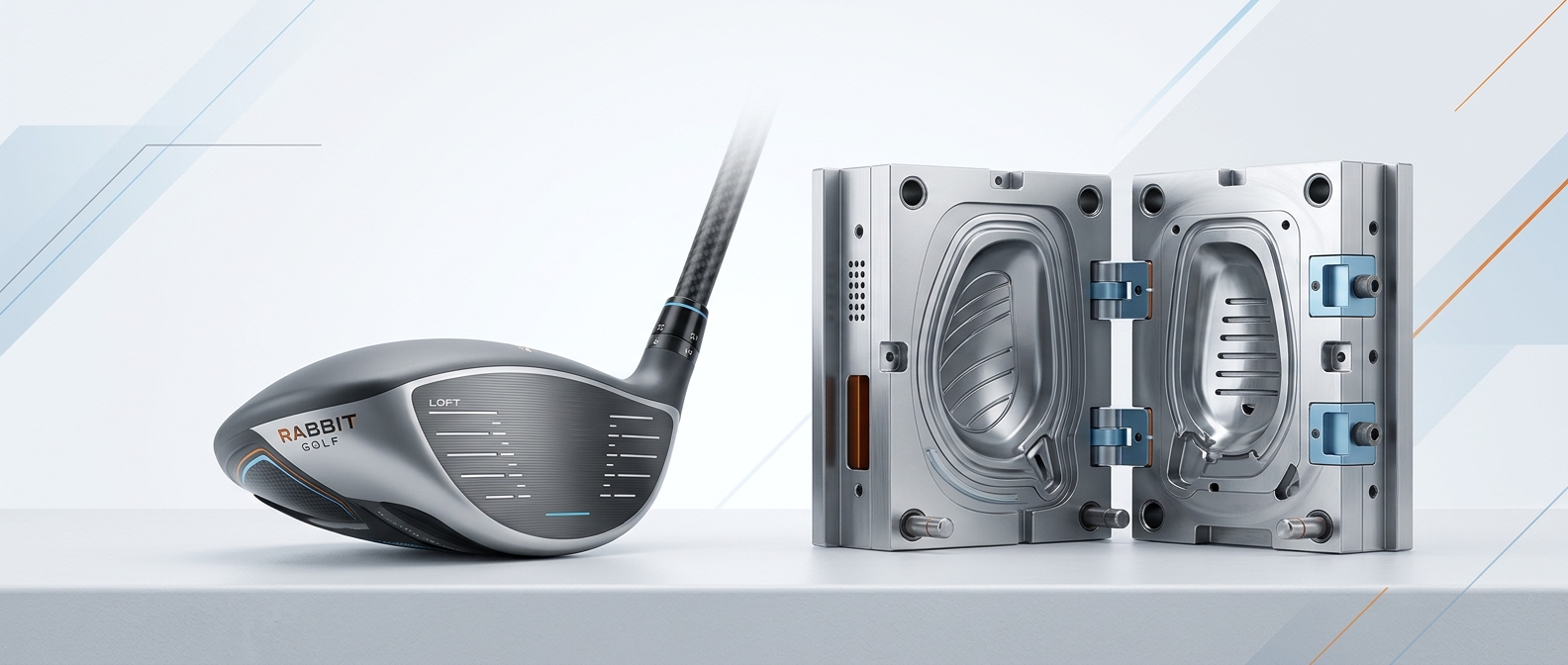
Golf Gear's Hidden Development Risks
Costly Mistakes Inventors Should Avoid
Executive Summary
Golf equipment looks simple from the outside, but it hides some of the toughest product-development decisions in consumer goods. Before you invest in tooling or materials, you need to understand four things: the conformance testing that can disqualify a finished product, the tooling path that determines whether your first production run bankrupts your budget, the material and process tradeoffs that separate a durable part from a warranty headache, and the automation and electronics choices that decide whether your idea can actually scale. Get these four decisions right early, and you avoid redesigns, wasted tooling spend, and delayed launches.
Schedule a Free Strategy Call Click Here
Introduction
A founder sends a beautifully rendered golf accessory to a factory, gets back a quote, and feels a wave of relief. Then the real questions start. Will the part survive repeated impact? Will the mold cost $3,000 or $80,000? Will a sensor embedded in the grip still work after a rainy round or a dishwasher accident? Will the finished product even be allowed on a course?
These aren't hypothetical worries. They are the exact decision points where golf-adjacent product ideas either move smoothly toward manufacturing or stall in expensive rework. This article walks through four of those decision points, drawing on engineering guidance, patent filings, manufacturing case studies, and governing-body documentation. By the end, you'll understand what separates a design that looks good in CAD from one that survives contact with a golf ball, a mold press, and a retail shelf.
Along the way, we'll look at real examples: a Mizuno driver head outfitted with sensors to study swing mechanics, a Virginia Tech 3D-printed golf grip, a Ping production cell redesigned for higher throughput, and the material choices inside a modern titanium driver. Each example points to a different kind of risk — regulatory, financial, technical, or operational — that product teams need to plan for before tooling gets cut.
Schedule a Free Strategy Call Click Here
The Rulebook You Didn't Know You Needed
Many founders assume that if a golf-related product performs well and looks professional, it's ready for market. That assumption misses a critical gap: golf clubs, balls, and certain accessories are subject to a formal conformance process that has nothing to do with manufacturing quality and everything to do with eligibility for competitive play.
The United States Golf Association runs a dedicated testing operation for exactly this purpose. The USGA continually tests golf equipment for conformance to the Rules, because without such rigorous equipment testing and research programs, advances in technology could soon overtake skill as the major factor in success. This isn't a rubber-stamp process. All components of a golf club are subject to evaluation by the USGA to determine a club's conformance, and some of the standards for golf clubs and other equipment require a detailed examination of intended use, with conformance determinations made on more than two thousand clubs, club components, and other items each year.
Why does this matter for a product team? Because submission timing and documentation shape your launch schedule. The preamble to the Equipment Rules states that a manufacturer should submit a sample of the equipment to be manufactured for a ruling, and while this submission is strongly recommended, it is not mandatory. Skip it, and you risk selling a product that later gets flagged. The USGA keeps that door open even after launch: based on samples submitted during conformance testing or information obtained from the marketplace, the USGA may perform check tests on clubs previously determined to be conforming, and if a club already being sold comes into question, the USGA may obtain marketplace samples and test them for conformance.
The practical lesson is sequencing. Conformance testing should run in parallel with engineering validation, not after tooling is finalized. A redesign triggered by a late conformance issue is far more expensive than one caught during prototyping.
Quick Answer: Conformance testing through the USGA Research and Test Center isn't mandatory, but skipping it risks a product being pulled from competitive use after launch. Build submission timing into your development schedule, not your post-launch plan.
Not sure whether your product needs regulatory or standards review before tooling? Rabbit Product Design can help you map that timeline into your development plan.
Schedule a Free Strategy Call Click Here
The Tooling Decision That Decides Your Budget
Here's a problem nearly every golf accessory or component maker runs into: the mold that makes your part can cost anywhere from a few thousand dollars to well over a hundred thousand, and choosing wrong in either direction creates real financial pain.
The visible problem is simple — tooling quotes vary wildly between suppliers and seem hard to compare. The deeper cause is that mold material and class determine both the price and the lifespan of the tool. Injection mold tooling runs about $3,000 for a single-cavity aluminum prototype tool, $12,000 to $60,000 for a production steel tool on a moderate consumer part, and $80,000 to $200,000 for a high-cavitation tool with hot runners and multiple side actions. Aluminum tooling earns its lower price through machining speed and material cost, but it trades away durability: aluminum prototype tools typically handle about 10,000 cycles before wear becomes a concern, while production-grade steel can run into the hundreds of thousands or millions of cycles.
That tradeoff creates a practical consequence many first-time product developers don't anticipate: committing to steel tooling before demand is confirmed. Protolabs' own guidance on supply chain risk warns that companies under schedule pressure are often tempted to skip prototype validation steps altogether, which only pushes design problems — and their cost — further downstream. While avoiding prototyping or reducing prototype revisions may have an immediate benefit, design issues that go undetected can significantly delay manufacturing when they're discovered during the production process.
The decision this leads to is what the industry calls bridge tooling: start cheap and soft, then graduate. Mold costs with aluminum-based tools are often dramatically more affordable than steel — think $10,000 versus $100,000 for a steel tool — and the integrity of piece-part price remains intact when total cost of ownership is considered, with no minimum order quantities or storage fees for excess inventory.
A few guideposts worth keeping in your back pocket:
Aluminum tooling suits validation runs and uncertain demand, generally under a few thousand units.
Steel tooling pays off once volume and design stability are both confirmed.
Mixed strategies — aluminum first, steel later — reduce the risk of over-investing in a design that might still change.
Tooling decisions should follow demand data, not optimism about future sales.
Does your product combine metal and plastic components, or do you need a second opinion on tooling strategy before committing capital? Rabbit Product Design can help you evaluate the right path for your volume and budget.
Schedule a Free Strategy Call Click Here
Why Material Choice Is Never Just About Performance
Golf club heads reveal one of the clearest lessons in product design: the "best" material on paper is rarely the easiest one to manufacture, and the gap between those two realities shows up as cost, lead time, and failure risk.
Titanium is the classic example. It's prized for strength-to-weight ratio, but it fights back during production. Titanium golf club parts are typically cast, stamped, or forged, and their composites are laid up by hand using pre-impregnated materials cured by compression molding or in an autoclave. Thin sections introduce their own headache: titanium cannot be cast or stamped any thinner, due to the need to post-weld parts together, and welding creates a heat-affected zone that can cause deformation in thin areas. That's a deeper technical cause behind a problem many teams discover too late — a part that looks fine in simulation but warps or cracks in the real mold or weld fixture.
Composite and multi-material designs raise the stakes further. Patent filings for modern club heads describe bodies built from carbon-fiber composite paired with titanium or stainless-steel faces, and the manufacturing sequence matters as much as the material list. A club head body can be further prepared for injection molding by precision machining the rear opening, because a cast or forged club head will typically lack a surface smooth enough to seal a mold around — tight tolerances are needed to provide a clean seal against the mold and prevent flash formation during injection molding. A hybrid approach documented in composite-manufacturing coverage combined a sintered composite body, a CNC-machined titanium face, and a machined brass weight — bonded, not welded — specifically to reduce touch labor and produce parts with tighter tolerances than those made from cast and forged metals, without time- and labor-intensive secondary operations.
The practical decision for a founder designing any metal-plastic-composite hybrid — golf equipment or otherwise — is this: define your dominant stress zones first, then choose a manufacturing process that can meet tolerance and bonding requirements there, rather than picking an exotic material and hoping tooling will catch up. Design for Manufacturability review exists precisely to catch this mismatch early. Design for manufacturability is the practice of designing a part so it's as easy, reliable, and cheap to manufacture as possible without compromising its function, and for molded plastic components the guidance is specific: for most engineering thermoplastics, the target nominal wall thickness falls between 1.2 mm and 3.5 mm, and adjacent wall areas should not differ by more than 25 percent, to avoid warping and sink marks.
Key Facts — Material Tradeoffs:
Titanium offers strength-to-weight advantages but requires casting, stamping, or forging, plus careful handling of weld zones.
Composite bodies reduce weight but need precise bonding surfaces to mate with metal faces or inserts.
Multi-material assemblies demand tooling and tolerance plans built around the joint, not just the individual parts.
Scaling Up Without Breaking What Works
Once a design clears prototyping, a new set of questions appears: how do you produce it consistently, at volume, without ballooning labor costs or introducing new defects? And if your product includes electronics or sensors, how do you keep that promise once it leaves the lab?
A 2025 case study of Ping's Phoenix facility shows the visible problem many growing manufacturers face: a molding process that works but requires too many hands and too much variability. Ping turned to an automation partner for a complete production cell that led to more and higher quality production of a decorative head-to-shaft transition component on its irons, in a process that requires fewer total operators. The upgrade wasn't cosmetic — the new cell incorporated an injection molding machine, a linear three-axis robot, a temperature control unit, and a granulator, and enabled Ping to shift from a four- to an eight-cavity mold. That's a direct link between automation investment and real output gains, echoed across the wider industry: companies that add robotic tending commonly report productivity increases in the range of 15 to 30 percent after installing robotic automation, with many cells paying for themselves within 12 to 18 months through labor savings and higher throughput.
Electronics add a different kind of complexity. PTC's demonstration project with a Mizuno driver shows the appeal of embedding sensors directly into sporting goods: Brown outfitted the center track of the golf club head with an accelerometer and gyroscope, with a cable running from the sensors along the track, up the shaft, and into his wrist — though in practice, nearly all of today's commercial sensor products use wireless, battery-powered modules rather than wired sensors. But embedding any electronics into a product meant to survive impact, weather, and repeated handling introduces durability questions that go well beyond golf. Research on wearable sensors for sports consistently flags the same failure points: battery life and washability are the main technical barriers to integrating sensors into smartwear, and textile-integrated sensors face energy density limits and degrade significantly after just 10 to 15 wash cycles. The same principle applies to any IoT-enabled consumer product exposed to moisture, impact, or temperature swings — enclosure design and connector choice matter as much as the sensor itself.
The decision this points to is sequencing again, but in a different place in the lifecycle: validate your automated production cell and your electronics enclosure strategy before you scale marketing or distribution. A great product that can't be produced consistently, or whose electronics fail in the field, creates returns and lost trust faster than almost any other mistake.
Building a product that pairs mechanical parts with embedded electronics? Rabbit Product Design can help you evaluate enclosure design and production readiness before you scale.
Schedule a Free Strategy Call Click Here
Bringing It Together
Four decisions shape whether a golf-related product — or really any physical consumer product with similar complexity — moves smoothly from concept to shelf:
Confirm regulatory or standards conformance early, not as a final checkbox.
Choose tooling material based on confirmed demand, not optimism, and consider a bridge strategy.
Match your material choice to a manufacturing process that can actually hit your tolerance and bonding requirements.
Validate automation and electronics reliability before scaling production or marketing spend.
None of these decisions exist in isolation. A material choice affects tooling cost. Tooling strategy affects how fast you can respond to demand. And production scaling only works if the underlying design was already manufacturable. Treating these as a single connected sequence — rather than four separate conversations — is what separates teams that launch on schedule from teams that spend a year reworking the same part.
Let's Talk About Your Product
If you're weighing material choices, tooling investment, or how to bring sensors and automation into a physical product, a short conversation can save months of costly guesswork. Schedule a free strategy session with Rabbit Product Design. There's no obligation, and your information can be protected under an NDA. Use the session to gain practical guidance on the next step for your product.
Schedule a Free Strategy Call Click Here
References
Plastics Technology — Golf Equipment Manufacturer Scores Higher Productivity With Automated Cell
Protolabs — White Paper: Reducing Risk Through On-Demand Manufacturing
Protolabs — 10 Ways Digital Manufacturing Can Improve Your Supply Chain
Enhance Product Development — Injection Molding Tooling Cost: What You Get
MW Molding — Prototype versus Production Tooling for Injection Molding
RJC Mold — Design for Manufacturability (DFM) in Injection Molding
Manufyn — Design for Manufacturability (DFM): A Practical Guide for Engineers
USPTO — Multi-Material Iron Golf Club Head (Patent 12011643)
Automate.org — Industry Insights: Robots, the Plastics Molder's Best Friend
GlobalAT — Injection Molding Robots: Machine Tending Automation
Sansan Sports — Wearable Sensors and Smart Sportswear: The Connected Future