3D Printing Services & Creative Product Design Guide
3D printing services and product design consulting together give inventors and early-stage founders a faster, lower-cost path from concept to a manufacturable product. This guide is for inventors, entrepreneurs, and small business owners evaluating how 3D printing fits into a real product development process — what it costs, where it helps, and how to use it without getting stuck at the prototype stage.
Quick Answer
3D printing services give inventors and entrepreneurs the fastest way to turn a sketch into a working physical prototype. Product design consulting is what connects that prototype to a manufacturable product — covering mechanical design, electronics, materials, and design for manufacturing review. Used together, they remove the upfront tooling costs that traditionally kept first-time founders out of physical product launches. The global 3D printing services market was valued at USD 5.3 billion in 2022 and is projected to reach USD 20.4 billion by 2030.
Key Facts
- 3D printing services market projected to reach USD 20.4 billion by 2030 at 18.4% CAGR — service bureaus are the fastest-growing segment of the broader 3D printing market [source]
- 89% of 3D printing users reported improved time-to-market in 2023 — the single clearest measurable benefit for product teams under launch pressure [source]
- 82% of engineers surveyed by Protolabs in 2024 said 3D printing helped save substantial costs in their manufacturing pipeline [source]
- 78% of enterprises used 3D printing for prototyping in 2023 — confirms prototyping as the dominant application, not end-use production [source]
- 70% of engineers printed more parts in 2024 than in 2023 — sustained year-over-year growth in professional 3D printing demand [source]
- Professional 3D printing services cost $3 to $1,000+ per part with no tooling required, making them cost-effective for production runs under roughly 1,000 units — removes the upfront investment that traditionally locked individual inventors out of physical product launches [source]
First-time inventors and small founders have long faced the same wall: a real idea, a sketch, maybe a rough prototype, and no realistic path to a manufacturable product. The combination of 3D printing services and full product design consulting collapses that gap. The print produces the part. The design work makes sure the part actually holds up at scale. Teams that try to do one without the other usually pay for it later — in tooling rework, in missed launches, or in products that ship and get returned.
Key Takeaways
- 3D printing services give inventors a fast, low-cost way to test a physical idea without committing to tooling.
- Product design consulting is what turns a print into a product — covering tolerances, materials, and manufacturability before any production money is spent.
- Service costs run from $3 to $1,000+ per part depending on technology and material, with no minimum order on most platforms.
- Inventors working in consumer products, soft goods, hardwood items, and electronic products benefit most from combining 3D printing with full product design support.
- Senior-engineered design support reduces the rework cycle that kills most first-time product launches.
- A single end-to-end team (design + prototype + manufacturing support) tends to be faster and less error-prone than stitching together three separate vendors.
Table of Contents
- What Are 3D Printing Services and Where Do They Fit Into Product Design?
- How Does Product Design Consulting Reduce Risk for Inventors and First-Time Founders?
- What Do 3D Printing Services Cost in 2026 and How Are Prices Structured?
- Which Types of Products Benefit Most from 3D Printing in the Design Process?
- How Do You Choose the Right 3D Printing Service for Your Product?
- How Does the Collaborative Design Process Accelerate Product Launches?
- How Rabbit Product Design Supports Inventors from Concept to Manufacturing
What Are 3D Printing Services and Where Do They Fit Into Product Design?
3D printing services are on-demand manufacturing platforms that produce physical parts from digital CAD files, typically using FDM, SLA, SLS, MJF, or DMLS technologies. For most inventors and entrepreneurs, they are the fastest, lowest-risk way to turn a concept into something you can actually hold, test, and show to a manufacturer.
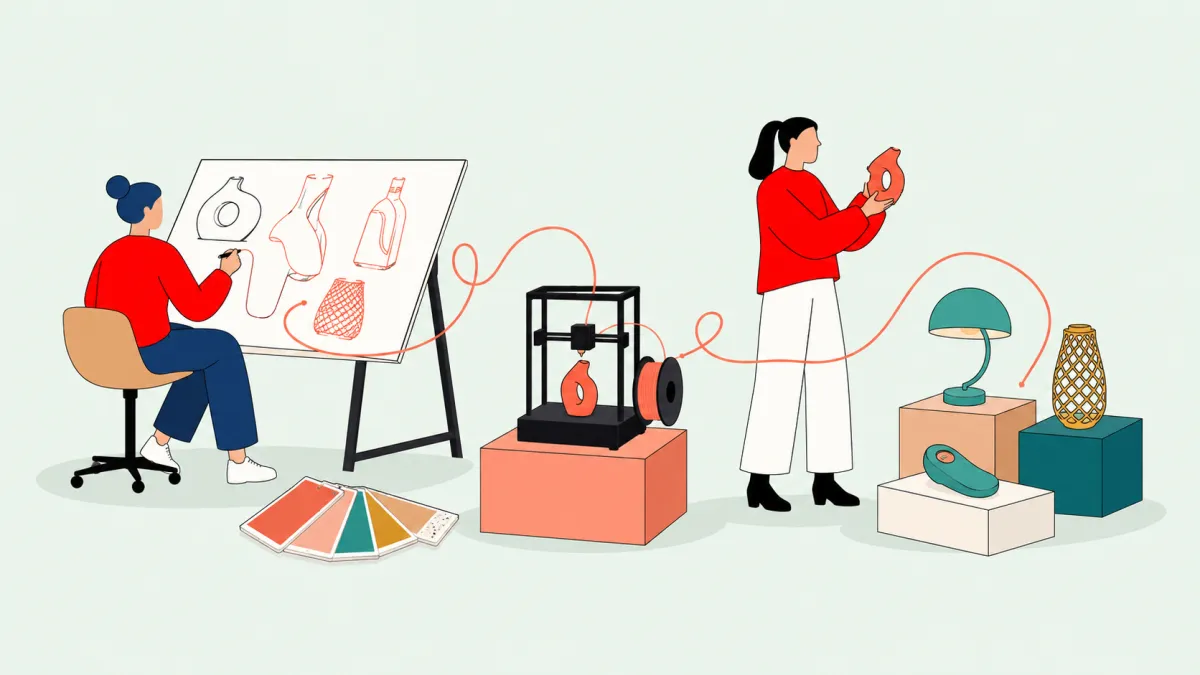
In a product design process, 3D printing usually sits between concept and tooling. After industrial design and basic mechanical engineering are done, a printed prototype answers questions that a digital render cannot — does the part fit in the user’s hand, do the components assemble cleanly, does the geometry actually function the way the drawings suggested.
Online services accept uploads 24/7, generate instant quotes, and typically ship parts in 1–10 business days with no minimum order. Industrial services charge $20–200+ per part depending on size and material; maker-style services can deliver functional prototypes for $1–5 per machine hour. For an inventor working on a first prototype, that flexibility matters more than absolute price — it means version one of an idea costs hundreds, not tens of thousands.
3D printing is one prototyping method, not the whole toolkit. CNC machining is often the right call for metal parts and tight tolerances. Soft tooling and silicone molds become relevant once a design is closer to production. The practical framing for first-time founders is: 3D printing answers early questions cheaply, and other methods take over as the product gets closer to manufacturing.
- FDM handles PLA, PETG, ABS, TPU, and nylon — covers most early consumer-product prototypes.
- SLA and PolyJet deliver the surface finish needed when appearance matters for user testing.
- SLS and MJF parts retain about 80% of the strength of the same part injection-molded.
- No tooling costs exist with 3D printing, which is what makes it accessible to individual inventors.
- Industrial print bureaus, maker marketplaces, and local print shops each serve different project stages and budgets.
By 2025, the 3D printing industry surpassed $30 billion in global market size, with service providers supporting everything from single-unit prototypes to small production runs.
How Does Product Design Consulting Reduce Risk for Inventors and First-Time Founders?
A printed prototype that doesn’t translate to manufacturing isn’t really a prototype, it’s a souvenir. Product design consulting is the work that connects what 3D printing can produce to what a manufacturer can build at scale. For inventors who haven’t been through a product launch before, this is where most of the saved cost lives.
The common pattern: an inventor pays for a beautiful prototype that ignores wall thickness, draft angles, tolerance stack-ups, or how the material will actually behave at scale. Tooling quotes come back at three times the budget. The design has to be redone. Months are lost. Design for manufacturing review at the prototype phase catches these problems when correction costs hundreds of dollars instead of tens of thousands.
Integrated product development combines industrial design, mechanical engineering, and electronics design into one workflow. The handoff errors that kill timelines — version mismatches, geometry that works in CAD but fails in a mold, electronics layouts that conflict with the mechanical housing — happen at the gaps between separate vendors. A single coordinated team removes most of those gaps.
This matters most for first-time founders. People who have already developed several products know how to manage multiple vendors and how to spot when one is leading them astray. Someone working on a first idea usually doesn’t, and the cost of learning that by trial and error is what destroys most early product launches.
- DFM reviews catch geometry, tolerance, and material problems before tooling is committed.
- Electronics design consulting validates PCB layouts, thermal behavior, and component fit inside the mechanical housing.
- Patent research at the prototype stage identifies prior art before significant capital is committed.
- User testing with physical prototypes surfaces ergonomic and assembly issues that digital renders hide.
- Working with a single senior team avoids the handoff errors that cause most rework.
82% of engineers surveyed by Protolabs in 2024 said 3D printing helped save substantial costs in their manufacturing pipeline.
What Do 3D Printing Services Cost in 2026 and How Are Prices Structured?
3D printing service prices in 2026 range from about $3 for a small FDM part to over $1,000 for large metal DMLS components. Seven variables drive the final number: material, print time, part complexity, technology, post-processing, rush status, and any required certifications. For inventors, the practical advice is to get two or three itemized quotes — line-item breakdowns reveal which design choices are inflating the price.
Desktop-grade FDM services run roughly $15–25 per machine hour. Industrial SLS, MJF, and metal DMLS services are $50–200 per hour. Material costs swing widely: PLA filament is $50–80 per kilogram; titanium runs $300–600. Technology selection is the highest-leverage decision in the quoting process — picking the right process for the geometry saves more than negotiating with any one vendor.
Rush orders typically carry a 50–100% surcharge. Compliance-grade work — medical, aerospace, certified materials — can add significant cost due to documentation and biocompatible material requirements. Most early-stage inventor projects don’t need any of this. If a vendor is pushing certifications a project doesn’t require, that’s a signal to look elsewhere.
By part size: small parts under 50mm cost $5–25, medium parts (50–150mm) run $15–75, and large parts over 150mm cost $50–300+. Post-processing — sanding, painting, plating — adds $10–100+ per part. Specify it only where surface finish is genuinely critical to the test you’re running.
- FDM is the cheapest process; DMLS/SLM is 5–10x more expensive for the same part volume.
- No tooling costs exist with 3D printing, versus $5,000–$50,000+ for injection mold tooling.
- Above roughly 1,000–5,000 units, injection molding’s amortized unit cost beats 3D printing.
- Batch orders to hit volume breakpoints and avoid rush surcharges.
- Itemized quotes are more useful than lump-sum quotes for identifying cost drivers.
Professional 3D printing services charge $3 to over $1,000 per part in 2026, with industrial SLS, MJF, and metal DMLS services running $50–200 per machine hour.
Which Types of Products Benefit Most from 3D Printing in the Design Process?
Most physical product categories benefit from 3D printing somewhere in development. For inventors and small founders specifically, five categories see the biggest gain: consumer products, soft goods with structural components, hardwood products with mechanical parts, electronic products and IoT devices, and any patented invention that needs a functional proof-of-concept before licensing or production.
Consumer products are the broadest category — kitchen tools, household goods, organizational products, lifestyle accessories, and the long tail of small inventions that show up on Amazon. Most start as a sketch, get printed to test fit and function, and then move into mechanical design refinement before tooling. The cost-of-failure at the print stage is low enough that founders can iterate three or four times for less than the cost of a single mold revision later.
Soft goods — bags, cases, pet products, sports gear, wearables — rely on flexible materials, but they almost always include structural hardware: buckles, frames, clips, mounting plates. 3D printing those rigid components alongside the fabric prototyping is now standard practice. It lets the soft-goods design and the hard components evolve in parallel rather than waiting on each other.
Hardwood products — furniture, displays, fixtures, storage products — usually combine wood with metal or plastic parts. 3D printed brackets, joinery, and mounting hardware are useful for testing fit before CNC routing the wood itself. Electronic products and IoT devices use 3D printing for enclosures, button mechanisms, and connector housings while PCB design runs in parallel.
For inventors holding a patent or preparing one, a 3D printed working model is often the difference between a licensing meeting that goes nowhere and one that ends with real interest. A model that works is significantly more persuasive than a drawing.
- Consumer products: 3D printing replaces multiple rounds of expensive tooling revisions.
- Soft goods: structural hardware (buckles, frames, mounting plates) prints alongside fabric prototypes.
- Hardwood products: brackets, joinery, and hardware can be tested before committing to wood machining.
- Electronic products: enclosures and housings print in parallel with PCB development.
- Inventor proof-of-concept: a working physical model is far more persuasive than a sketch in patent and licensing conversations.
78% of enterprises used 3D printing for prototyping in 2023, confirming prototyping as the dominant application across product development.
How Do You Choose the Right 3D Printing Service for Your Product?
For most inventors and small founders, choosing a 3D printing service comes down to four practical questions: does the service support the technology your part actually needs, can it deliver in the timeframe your project requires, will it tell you when your file has problems, and does the quoted price include the things you actually need.
Material and technology range matters more than headline price. A service that only offers FDM forces compromise on parts that need SLS strength or SLA surface finish. A service covering FDM, SLA, SLS, and at least one metal process gives a developing project room to match technology to component without switching vendors mid-project.
DFM feedback is the most underrated service feature. A printer that just prints whatever you upload will print exactly what you uploaded, including the flaws. A service that flags wall thickness issues, unsupported overhangs, or geometry that will deform during printing saves entire rounds of iteration. Ask about DFM consultation before placing an order, not after.
Lead time reliability is more important than fastest advertised lead time. A service that quotes three days but ships in nine has cost you a week of project time. Third-party reviews are a better signal here than vendor marketing claims.
- Request itemized quotes — line-item breakdowns reveal geometry-specific cost drivers.
- Confirm DFM consultation is included, not an upcharge add-on.
- Verify the service supports more than one technology, so you aren’t locked in by their equipment.
- Check lead time reliability through reviews and direct references, not advertised times.
- For regulated work, confirm certification documentation capability before ordering.
70% of engineers surveyed by Protolabs in 2024 printed more parts than in 2023, confirming sustained growth in professional 3D printing service demand.
How Does the Collaborative Design Process Accelerate Product Launches?
The collaborative design process runs industrial design, mechanical engineering, electronics design, and 3D printing services in parallel rather than sequentially. For most hardware products, this compresses development timelines significantly compared to running the disciplines one after another, and removes the version-control failures that cause most prototype rework.
The mechanism is simple: industrial designers and mechanical engineers working in a shared CAD environment catch interference and tolerance problems while the design is still cheap to change. Electronics engineers fitting boards inside that same housing surface conflicts in days, not weeks. A 3D printed prototype delivered into this process tests whether the parallel work actually fits together. The next iteration starts within days of the first print arriving.
Physical prototypes are the part of the process that can’t be replaced by software. Ergonomic issues, assembly interference, button feel, weight distribution — these only show up with a part in hand. For consumer products especially, the difference between a product that sells and a product that gets returned is usually visible at the first physical prototype, if anyone is looking for it.
Patent research integrated at the prototype stage prevents freedom-to-operate problems that derail launches at commercialization. The right time to discover a blocking patent is before tooling is committed, not after the first production run.
- Parallel design workflows compress hardware development timelines compared to sequential workflows.
- Physical prototypes reveal ergonomic and assembly issues invisible in digital renders.
- Shared CAD environments eliminate version-control errors between mechanical and electronics teams.
- Patent research at the prototype stage prevents freedom-to-operate failures at launch.
- Manufacturing-aware design from day one avoids the rework cycle that sinks most first products.
89% of 3D printing users reported improved time-to-market in 2023.
How Rabbit Product Design Supports Inventors from Concept to Manufacturing
Rabbit Product Design is a product development firm built specifically for the audience most product design firms ignore: inventors, entrepreneurs, and early-stage founders working on their first physical product. The firm has been in business for nine years, has developed over 2,000 products, and is staffed by senior engineers — with an average of 27 years of experience per team member — rather than the junior staff that handle most early-stage projects at larger firms.
The service model is end-to-end. Industrial design, mechanical engineering, electronics design, prototyping (3D printing, CNC machining, and soft tooling), manufacturing sourcing, and patent support are delivered by one coordinated team. Clients can engage the full process from sketch to production, or pull in individual services at a specific stage. That breadth is what lets first-time inventors move from a napkin sketch to a manufacturable product without rebriefing three or four separate vendors along the way.
Rabbit’s focus reflects who actually needs end-to-end product design help: consumer products of all kinds, soft goods (bags, cases, wearables, sports gear, pet products), hardwood products (furniture, fixtures, displays, storage), electronic products and IoT devices, and inventor or entrepreneur projects spanning every category. Most clients are individuals or small business owners, not corporate procurement teams.
Three things shape how the work runs day-to-day. Senior engineers handle every project from the start — there is no junior tier doing the early work. DFM is embedded throughout the process, not added as a separate review at the end. And the firm is built to be accessible to people developing a first product, not just funded startups with seven-figure budgets.
Key Services
- Industrial design and creative product design
- Mechanical engineering and electronics design
- Prototyping: 3D printing, CNC machining, soft tooling
- Patent research and patent support
- Manufacturing sourcing and production support
Key Benefits
- Senior engineers on every project, with an average of 27 years of experience
- One coordinated team from concept to manufacturing — no agency handoff errors
- 9 years and over 2,000 products of accumulated process experience
- End-to-end services accessible to individual inventors, not just funded companies
- DFM and manufacturing thinking embedded from the first prototype
To start a product development engagement that covers design, prototyping, and manufacturing support under one team, contact Rabbit Product Design.
Conclusion
3D printing services have made it cheap to test a product idea. Product design consulting is what turns those tests into a manufacturable product. For inventors and early-stage founders, the combination is the difference between an idea that gets stuck at the prototype stage and one that reaches the market. The global 3D printing services market is projected to reach USD 20.4 billion by 2030, and the gap between people who use it well and people who don’t is widening. To start a product development engagement with senior engineers and full process coverage, contact Rabbit Product Design.
FAQ
What is the minimum order quantity for online 3D printing services?
Most online 3D printing services have no minimum order quantity, which is what makes them practical for first-time inventors testing single-unit prototypes. Injection molding by contrast requires $5,000–$50,000 in tooling investment before the first part is produced.
How does design for manufacturing differ from standard product design?
Standard product design focuses on form, function, and user experience. Design for manufacturing adds a production-readiness layer: wall thickness, draft angles, tolerance stack-ups, and material selection against the manufacturing process being used. Integrating DFM into the prototype phase catches production problems while they’re still cheap to fix.
Can 3D printing replace CNC machining for metal parts?
Sometimes. DMLS and SLM are direct alternatives to CNC machining for complex metal geometries that are difficult or impossible to machine. For tighter tolerances than ±0.1mm, or fine surface finishes on critical mating faces, CNC machining is still preferred. Many product development workflows use both at different stages.
What file formats do professional 3D printing services accept?
Most professional services accept STL, STEP, OBJ, and 3MF. STEP is preferred for parts with tight tolerance requirements, because it preserves dimensional documentation that other formats strip out. A well-prepared upload with defined tolerances and surface finish callouts speeds up quoting and reduces interpretation errors.
Should I get a patent before prototyping?
A provisional patent application can be filed at the prototype stage and is often the right call. Filing locks in a priority date while design and testing continue. Working with a product design firm that includes patent research can save significant time on this step and reduce the risk of finding a blocking patent late in the process.
Sources
- Rabbit Product Design Official Website
- Best Online 3D Printing Services for Sellers and Designers | Printie Blog
- Five Best 3D Printing Services: Verified For Precision, Speed & Cost Control
- 3D Printing Service Guide: Costs, Technologies, and How to Choose — Lecreator
- 3D Printing Trend Report 2024 — Protolabs Network
- 3D Printing Industry Statistics | 2026 Edition
- 3D Printing Services: How to Find the Best Option for Your Project — 3D Print Bounty
- How to Choose a 3D Printing Service: What to Look For — 3DPrintMap
- Your Complete Walkthrough For Using An Online 3D Printing Service
- 3D Printing Services Global Market Report 2026
- The State of 3D Printing Report
- 2025 3D Printing Ecosystem Report — LAVA
- 3D Printing Market | Global Market Analysis Report — 2036
- 3D Printing Statistics: Market Data Report 2026
- Best 3D Printing Service 2026: A Comparison of 8 Platforms
- 3D Printing Service Bureaus Market: Global Industry Analysis 2025–2032
- How to Choose 3D Printing Service: Avoid 7 Costly Mistakes — Additive Realm